The AI content production trap in developer marketing
96% of developer marketing teams have tried AI for content, but only 7% find it very useful. The gap between 96% and 7% is a strategy problem, not a tools problem.

96% of developer marketing teams have tried AI for content. Only 7% find it very useful. Why is that?
Teams are using AI to solve a bottleneck that was never the bottleneck. They're getting faster at producing content, when the constraint was always credibility. The teams winning on developer content in 2026 are using AI to get faster at judgment. The teams losing are using it to get faster at word count.
The Draft.dev 2026 Developer Marketing Survey (draft.dev) is where those numbers come from, and they line up with what's happening in the broader content market. Digiday reported in 2026 that only 26% of consumers now prefer AI-generated content, down from 60% in 2023, and that 52% reduce engagement when they suspect content is AI-generated (digiday.com). Developer audiences started skeptical. They've only gotten harder to convince.
The wrong bottleneck
Production speed was never the bottleneck for developer marketing content. The constraint has always been credibility. Does this content come from someone who has actually built something with the product? Did the writer hit the errors? Did they figure out the workaround? Did they suffer through the configuration step that eats up real time and never makes it into the docs? This entire blog, for example, comes from a place of someone who has spent decades marketing developer-focused products, constantly reinventing himself to match the times.
AI removes the production bottleneck. It doesn't touch the credibility bottleneck. A team that publishes ten posts a week with AI assistance gets ten times louder. None of that extra volume makes the content any more credible.
I made the broader version of this argument in taste is the most valuable skill in marketing. Judgment, not execution, is the scarce resource in the AI era. This post is the developer-audience-specific version. With developer readers, the asymmetry is sharper. The execution problem was already mostly solved by tools and templates. The judgment problem was, and still is, the whole job.
Teams that celebrate publishing velocity are optimizing for the metric they can move, not the metric that matters. There's no leaderboard for developer trust. So you start tracking posts per week, and you fool yourself.
How do developers detect AI-generated technical content?
Developers read for what is missing more than for how the prose sounds. An article will describe the API correctly but skip the error you hit the moment your package versions conflict. A tutorial works fine in a clean sandbox and then breaks against real data. An auth walkthrough covers every step except the gotcha that costs most developers two hours of debugging. The descriptions are all accurate, and the lived experience behind them is still missing.
General audiences notice stylistic tells too: sentences that flow too smoothly, structures that are too tidy. But those aren't the main signal for developer readers.
A developer who has built with the product writes from that experience, while AI writes from the documentation, and a careful reader can tell which one they are reading within a couple of paragraphs.
PostHog explains this directly in their content guide (posthog.com): their content works because 100% of their staff write code. They publish content where the writer has shipped something. The result is content that earns links, reader responses, and references months after publication. The model is simple. AI doesn't scale it. Hiring people who code, and giving them time to write, scales it.
A 2026 Hacker News thread (news.ycombinator.com) caught a company that pushed 12,000 AI-generated posts in a single GitHub commit. The top comments skipped past detection tools entirely and went straight to trust overhead. Developers described how every technical article on the internet now requires a triage pass before reading: is this from someone who actually did the thing? That cognitive tax didn't exist two years ago. Every AI-generated post extends it.
On this website, I tried an experiment. I generated a 700 page "glossary" of industry terms. Each page focused on one word (e.g., "API", "Funnel Metrics", "Messaging"). Every page was auto-generated AI slop (though, I did edit them lightly). Before publication, my SEO and AEO numbers were pretty extraordinary. After publishing, the pages cratered my site metrics. Why? People found the content and bounced almost immediately, whereas most of my posts have the opposite effect. The lesson for me is clear. Use AI for research. Use my brain for content.
The asymmetry
The volume-trust tradeoff is asymmetric for developer audiences: publishing nothing does not destroy a developer content brand, but publishing a lot of low-quality content does. Trust decay with developer readers is faster and less reversible than with any other audience. One comment calling a blog "AI slop" in a developer Slack travels faster than six months of social promotion.
A developer who reads two AI-feeling posts in a row will unsubscribe. They'll mention it to their team. Maybe they'll post about it. Recovery is hard because developers remember. They remember which blog burned them, which docs were wrong, which company shipped a deprecated example as a tutorial. The community is small enough that reputations stick. A consumer brand can rehabilitate a content failure with a campaign. A developer content brand has to rebuild trust one post at a time, and the next reader is starting from skepticism.
I covered the strategic version of this in good marketing in the AI era. AI widens the gap between great and mediocre marketing. With developer audiences, the gap widens faster, because the audience is faster to write you off and slower to come back. Volume strategies in this category are betting against the gap. The gap usually wins.
What AI is actually good for here
AI earns its keep in developer content in three specific places: compressing research across many sources into a brief, generating outline alternatives for editorial review, and scaffolding first drafts for the parts that don't require lived experience. The 7% who find AI very useful treat it as a tool and keep a human in the author's seat.
First, research compression. AI is good at reading thirty sources and producing a brief. The brief is the thing the human author reads before writing. The brief is not the article. Second, outline alternatives. AI can produce four different ways to structure a piece in a few minutes, which is the kind of low-stakes generative work humans are slow at. The author still picks. Third, first-draft scaffolding for the parts that don't require lived experience, like the introduction, the summary table, and the transition paragraphs. These are the places where the value is structure rather than insight.
Where AI fails is as the primary voice and as the source of technical examples. The voice has to come from someone who has lived the work. The examples have to come from someone who has actually run them and broken them. PostHog doesn't put it in those words, but the practice is exactly the same: humans with product experience write the content. AI doesn't change that constraint. It just lets those humans skip a few hours of research and outlining.
Proprietary research is the only content moat left made the case that original data and original insight are the only durable content advantages. AI use that produces neither is producing commodity output. AI use that compresses the path to original insight is producing real advantage.
The outsourcing angle
42% of developer marketing teams outsource content creation, according to the Draft.dev 2026 survey, which makes it the most commonly outsourced marketing function. Some of that money buys real specialists who have shipped code in the relevant category. Some of it buys vendors who use AI to produce text at scale and add a human review pass.
The teams that can't tell the difference in their contracts are the teams whose content will degrade. The question to ask any content vendor is one sentence long. What percentage of your writers have shipped code with this kind of product? If the vendor has a good answer, you're buying expertise. If they pivot to talking about their editorial process or their AI workflow, you're buying volume.
The pressure to use AI for volume is often not a leadership choice. It comes from being understaffed. I wrote about this in the one person marketing team is a trap. When one person is expected to produce the content output of three, AI gets reached for as a coping mechanism. That's a structural problem, and better prompts won't solve it. The honest answer is that one marketer can't do three jobs, and the org that pretends otherwise pays for it in trust. For the broader strategy framework, see developer content strategy.
The audit question to take back to your desk is simple. When did someone on your team last publish something they learned from actually building with the product? Date that post. If it was last week, you're in good shape. If the most recent one is months back, the content program is running on AI fumes regardless of what the dashboards say. Everything AI is good for in developer content is a supplement to that baseline, not a replacement for it.

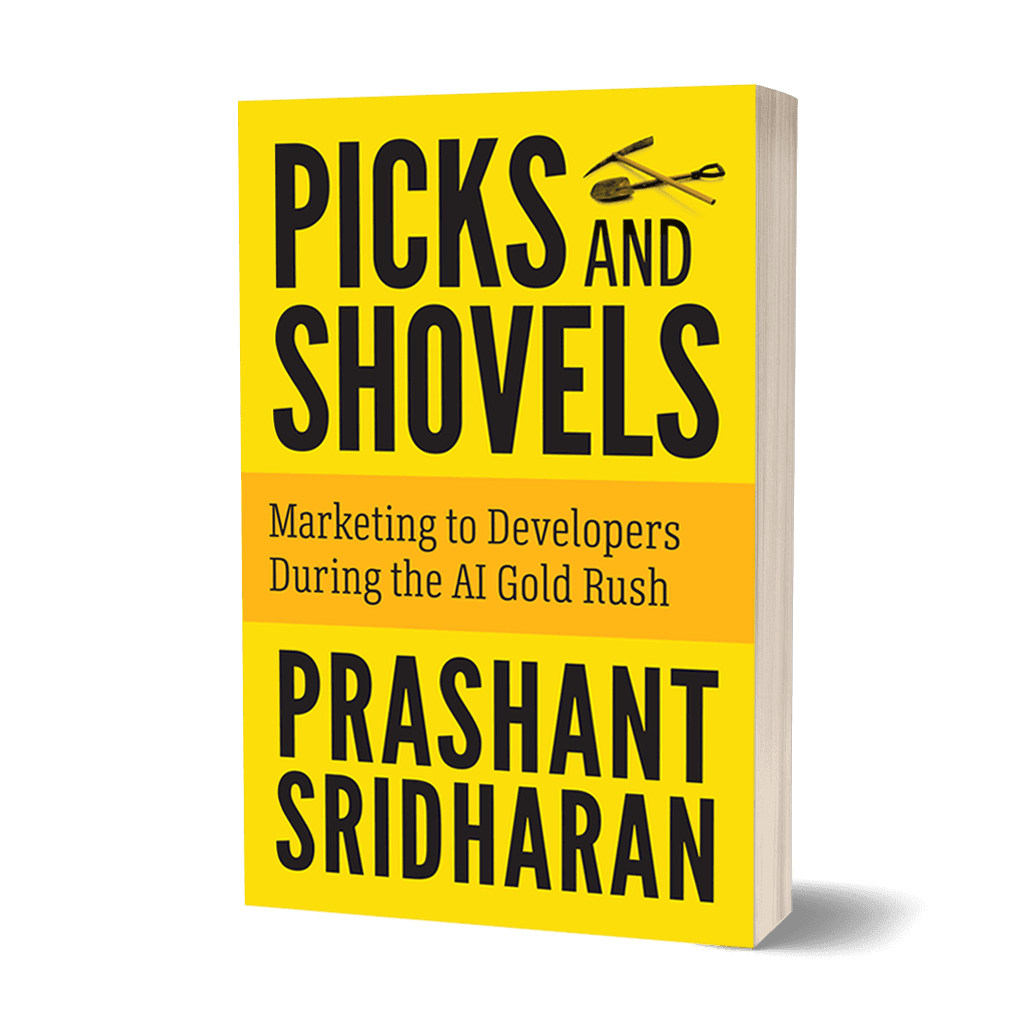
Developer marketing expert with 30+ years of experience at Sun Microsystems, Microsoft, AWS, Meta, Twitter, and Supabase. Author of Picks and Shovels, the Amazon #1 bestseller on developer marketing.
Want the complete playbook?
Picks and Shovels is the definitive guide to developer marketing. Amazon #1 bestseller with practical strategies from 30 years of marketing to developers.