The one-person marketing team is viable. It is also a trap.
Companies are hiring one PMM and expecting AI to do the rest. Some of that expectation is fair. Most of it is not. Here is where the line is.

The one-person marketing team is viable at the seed and early Series A stage. It becomes a trap when companies expect one person plus AI to cover eight functions at the same quality as a full team.
More startups are being founded by a single person, and the software a solo operator needs costs less every year. Companies are looking at that shift and drawing a conclusion that sounds reasonable: if one person can run a company, one person can run marketing.
They are half right. And the half where they are wrong is burning people out.
I wrote the first marketing hire survival guide for people who land in this role. This post is about the structural problem behind it: the expectations being set for solo marketing hires in 2026 are not aligned with what one person can actually do, even with AI.
What does AI make possible for a one-person marketing team?
Start with the honest case for it, because there is one. I use AI in my own marketing workflow every day, and a few jobs that used to need a full staff now sit comfortably with one person:
First drafts. Blog posts, email sequences, social copy, landing page text. AI produces usable first drafts in minutes. You still need to edit them aggressively (AI-generated content that ships unedited is a trust destroyer), but the drafting time drops by a lot.
Research. Competitive analysis, market research, customer interview synthesis. I wrote about using AI for competitive analysis and the time savings are real. What used to take two weeks takes two days.
Repetitive production. Social post variants, email A/B test versions, SEO metadata, image resizing. The mechanical parts of marketing that used to eat entire afternoons.
Data analysis. Campaign performance, funnel metrics, content engagement patterns. AI is good at finding the signal in the noise, as long as you know which questions to ask.
One marketer with AI can produce the output volume of two to three marketers from 2022. That part is true.
What can AI not replace for a solo marketer?
Four things stay stubbornly human: judgment, relationships, strategy, and cross-functional influence.
Judgment. AI generates options. It does not know which option is right. I wrote about taste as the most valuable marketing skill for exactly this reason. One person with AI still needs to evaluate every output, make every positioning call, and decide what to kill. That takes time and mental energy that does not scale with tooling.
Relationships. Customer conversations, sales alignment, executive communication, community engagement. These are one-at-a-time interactions that require presence and attention. AI cannot sit in a customer interview and notice that the CTO's face changed when you mentioned a competitor. AI cannot build rapport with a community leader over months of genuine interaction.
Strategy. Positioning requires understanding your market, your competitors, your customers, and your product deeply enough to make a choice about what to say and what not to say. AI can generate positioning options. It cannot evaluate whether those options are right for your specific market at this specific moment. That requires context that only accumulates through time spent in the role.
Cross-functional influence. The hardest part of being a solo marketer at a startup is getting the engineering team to take your input seriously, getting the CEO to approve your positioning, and getting sales to use your materials, not the work itself. These are political skills. They require trust, credibility, and persistence. AI does not help with any of it.
Quality control at scale. One person can produce more content with AI. But one person still has the same number of hours to review, edit, and ensure quality. If you triple your output, you need to triple your review time or accept that quality drops. Most solo marketers triple the output and do not triple the review time. The quality drops. The audience notices.
Why is the one-person marketing team a trap?
The role itself is doable. The trap is the set of expectations around it, which usually get set by people who do not understand marketing.
A CEO reads an article about how AI makes one marketer as productive as three. They hire one marketer. They expect the output of three. When the marketer cannot deliver, the CEO concludes they hired the wrong person. They did not. They set the wrong expectations.
The solo marketer burns out because the scope is too wide. The work is not too hard. There is just too much of it. They are doing content, SEO, campaigns, events, product marketing, competitive analysis, sales enablement, community management, and analytics. They are doing all of it "with AI," which means they are doing all of it alone with a tool that makes the typing faster but does not reduce the number of decisions.
By month six, the solo marketer is shipping a lot of mediocre work instead of a little great work. They know it. They hate it. They start updating their resume.
What should companies do for their solo marketer?
Set realistic scope. A solo marketer with AI should own two to three functions well, not eight functions poorly. If your priority is positioning and content, say so. Do not also expect event management, community building, and paid acquisition.
Measure quality, not volume. Ten blog posts that nobody reads are worse than two blog posts that drive signups. AI makes volume easy. Impact is the goal, not volume.
Budget for contractors. A solo marketer with a $5,000 monthly contractor budget can cover the gaps. A freelance designer for launch assets. A freelance writer for overflow content. A part-time community manager. The model works when the solo marketer is the strategist and editor, not the only pair of hands.
Plan the second hire early. If the solo marketer is working, start planning the second hire at month six, not month eighteen. The gap between "one person struggling" and "two people thriving" is smaller than most founders think.
Protect thinking time. The most valuable thing a solo marketer does is think: about positioning, about the market, about what to do next. If their calendar is full of production tasks, the thinking does not happen. AI handles production. The human handles judgment. Structure the role accordingly.
What is the real question about one-person marketing teams?
Stop asking whether one person can do it. Ask how long before they need help. The one-person marketing team is viable for a stage: seed to early Series A, limited product line, small market. AI extends that stage further than it used to go.
But viable and sustainable are not the same thing. If you are a founder hiring your first marketer, the question to ask is "how long before I need to give them help, and what does that help look like?", not "can one person do this with AI?"
The answer is sooner than you think.

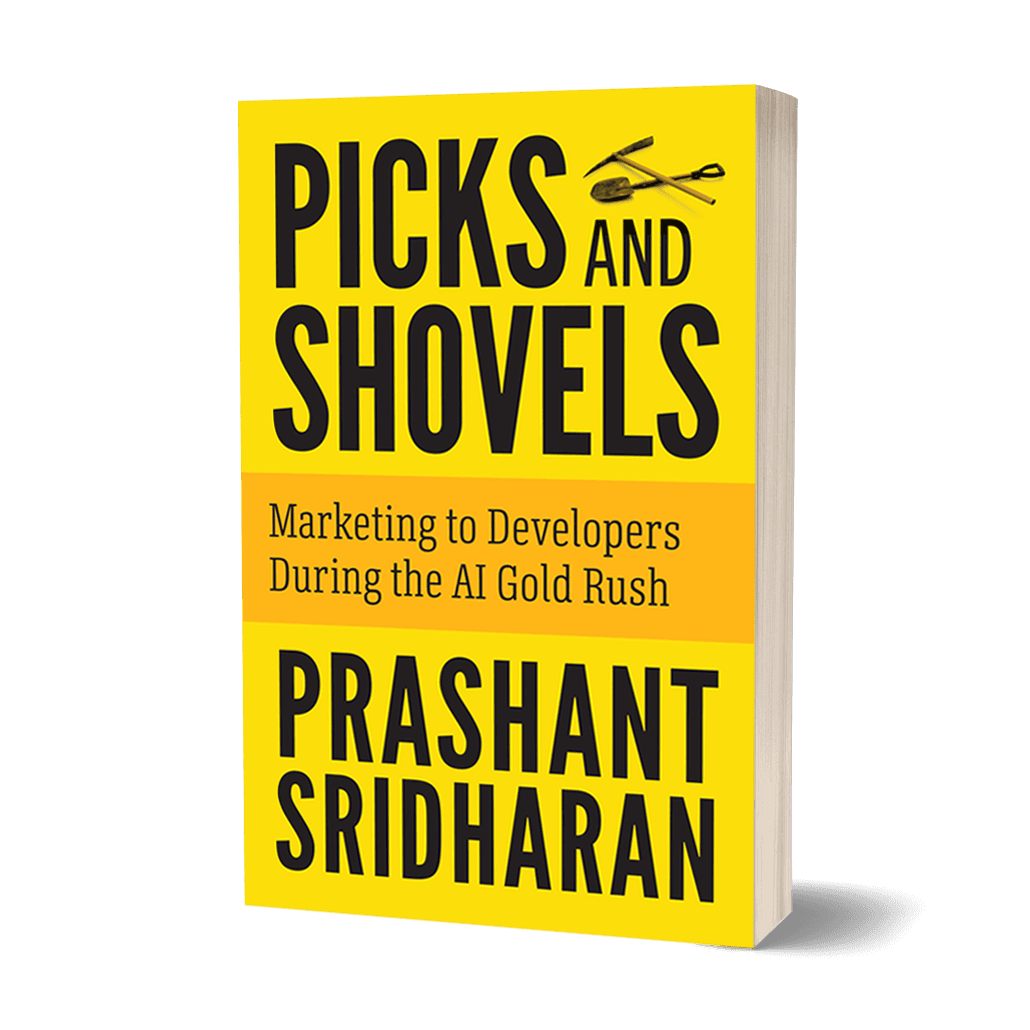
Developer marketing expert with 30+ years of experience at Sun Microsystems, Microsoft, AWS, Meta, Twitter, and Supabase. Author of Picks and Shovels, the Amazon #1 bestseller on developer marketing.
Want the complete playbook?
Picks and Shovels is the definitive guide to developer marketing. Amazon #1 bestseller with practical strategies from 30 years of marketing to developers.