Content Hub
Content Strategyfor Developers
Create content developers actually want to read. Learn what formats work, how to plan and produce content, and how to optimize for both human readers and AI assistants.
- Content Articles
- 14+
- Topics
- 4
- Content Types
- 12+
- Years Writing
- 30+
Content is the core of developer marketing
Developers learn by reading, watching, and doing. They evaluate products by reading documentation, following tutorials, and studying examples. Your content is often the first and most important touchpoint with potential customers.
Great developer content educates rather than sells. It solves real problems, provides complete working examples, and earns trust through accuracy and depth. This hub collects everything I have learned about creating content that developers actually want to read.
Explore by topic
Content Types
What content formats work for developers
Your changelog is a marketing channel
A blog post is easy to fake. A dated record of what you shipped, week after week, is not. That is why the least-loved page you own is doing the most work right now.
The art of reuse: turning a conference talk into a campaign
Forty hours of an engineer's time for twenty-five minutes in front of a hundred people is negative ROI. It only turns positive if the talk produces assets, and the first one you should demand is the blog post.
How to write a great developer case study
The Developer Q&A: case studies that developers don't hate
The 12 types of content that work for developers
I write a lot about content. I've provided a few tips on how to create content, a process for producing content within your Developer Relations team (hint: it's not just Developer Advocates writing st...
How to produce developer content
If you've been reading my blog posts thus far, you know that a big component of my go-to-market plan is producing massive amounts of great content. This content can take the form of blog posts, white ...
Using launch blog posts to drive growth of developer products
In our industry, we launch products constantly. When we're in the daily soup of running our business, we lose sight of the fact that 99% of our target developers don't give one iota of a damn about ou...






Planning and Strategy
How to plan and prioritize content
How to choose what developer content to build
One of your biggest challenges as a Developer Advocate will be determining which topics to focus on with your content. Often, Developer Advocates are given an edict to "build content and drive growth,...
Seven tips for building your content strategy
I am often asked by founders and DevRel leaders where they should focus their content efforts. I've done this work countless times at numerous companies, big and small. Take it from me. Here are seven t...
How to build an effective sales enablement strategy for early-stage startups
Sales Enablement is the goals/metrics, content, and accountability measures put in place to ensure that your sales team is armed with everything they need to most effectively do their jobs. In this po...
How to write a Market Requirements Document (MRD)
The MRD is the principle product strategy document. It is primarily accompanied by the Product Requirements Document (PRD). Sometimes, companies skip the MRD and PRD and go straight to listing out fea...




Content Production
How to create and produce content
How marketing supports the PRFAQ process
An LLM can produce a flawless PRFAQ in about ninety seconds. The value of the exercise sits in the argument your organization has about who it is fighting for, and that argument still costs something.
The content that can't be generated
I ran several experiments with AI generated content this last year. They all sucked. Here are the three kinds of content that still work, because they can't be generated.
How to write a great Getting Started Guide
Imagine you've seen chatter about a cool new product on social media or via word of mouth from your friends. You go to the website for this product, you get the gist of what it does, you see ...
How do you measure Developer Advocacy?
Measuring our work is important. Let's face it: not every company gets the role of Developer Relations. I'm not going to belabor the point, but in lean times demonstrating your value to the organizati...




Frequently asked questions
- What types of content work best for developer audiences?
- Twelve content types consistently work for developers: getting started guides, tutorials, reference documentation, API documentation, case studies, technical blog posts, video content, sample code and templates, comparison guides, migration guides, architecture guides, and interactive demos. All content must be technically accurate and genuinely useful.
- How often should you publish developer content?
- Quality matters more than frequency. One excellent, comprehensive guide per month beats four mediocre posts. Focus on evergreen content that remains valuable over time. Update existing content regularly rather than always creating new pieces. Most successful developer blogs publish 2-4 high-quality pieces per month.
- How do you write documentation that developers actually read?
- Lead with working code examples. Structure content for scanning with clear headings. Include copy-pasteable snippets. Explain the why, not just the how. Keep tutorials focused on one outcome. Test all code before publishing. Update docs when APIs change. Provide multiple ways to access information: quickstarts, tutorials, and reference docs.
- How do you optimize content for both SEO and AI assistants?
- Use clear heading hierarchy and semantic HTML. Include FAQ sections with schema markup. Structure content with explicit questions and answers. Use consistent terminology throughout. Add comparison tables for easy parsing. Keep paragraphs focused on single ideas. Update content regularly with clear modification dates.
- How do you measure the ROI of developer content?
- Track leading indicators like page views, time on page, and documentation searches. Measure conversion metrics like signups from content, documentation to signup rates, and content-influenced deals. Use multi-touch attribution to understand how content contributes to the buyer journey. Survey developers about how they discovered your product.
Explore more topics
This is one piece of the puzzle. Here are the other resource hubs.
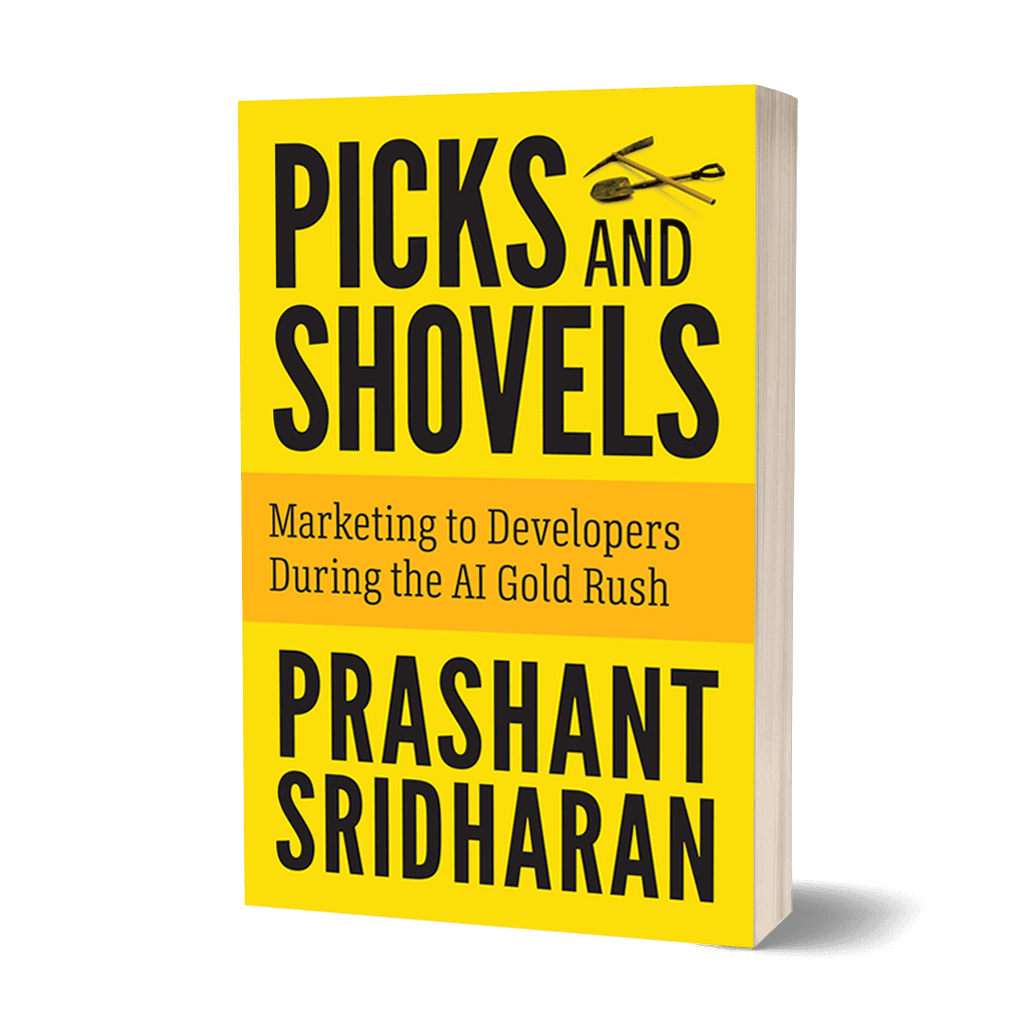
#1 Amazon best-seller
Want the complete playbook?
Picks and Shovels is the definitive guide to developer marketing: practical strategies from 30 years of marketing to developers.