Good marketing in the AI era
Everyone thinks AI makes marketing cheaper. I think it makes the gap between great marketing and bad marketing permanent. I am willing to bet my career on this.

Good marketing in the AI era is original research, sharp positioning, authentic community, and stories only you can tell. Everything else is commodity content no one will read.
I have been in marketing for thirty years. I have been wrong about many things.
But I have one belief about AI and marketing that I would stake my entire professional reputation on.
Instead of making marketing cheaper, AI will make the gap between great marketing and bad marketing unbridgeable.
Unbridgeable means exactly that. Once the gap opens, you cannot close it. The companies on the wrong side will not catch up in a quarter, or in a year, and maybe not ever.
I know this sounds extreme. The evidence says it is not.
The consensus view
Talk to any leader in tech right now and you will hear some version of the same pitch: "We can produce ten times the content with half the team." Marketing budgets are being cut because AI "does the work." In this world, headcount and costs go down and output goes up.
Yes, there are companies producing ten times the content. The content is fine. It is grammatically correct. It hits the right keywords. It follows the right structure. It is... adequate.
Unfortunately for them, every other company with the same tools is producing the same adequate content. The same blog posts. The same email sequences. The same landing pages. The same social media threads.
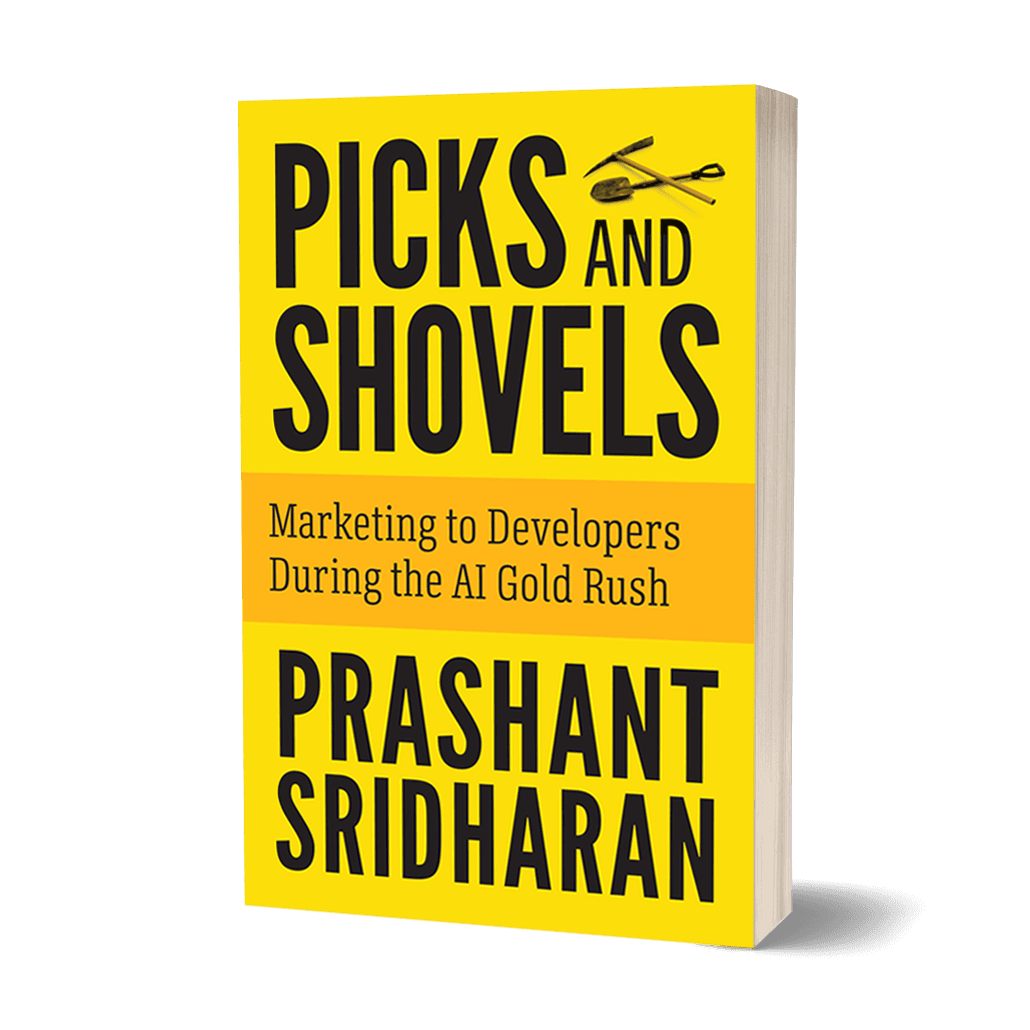
When I wrote Picks and Shovels, I talked about the importance of being "audacious" with content (a riff off Mark Schaefer's book Audacious: How Humans Win in an AI Marketing World.) It's about telling stories that only you can tell. About the power of storytelling in developer marketing and how it separates signal from noise. AI has made that advice a hundred times more urgent. Because audacious content used to compete with mediocre content. Now it competes with infinite mediocre content.
I also believe that in a world of immense sameness, the only way to stand out is to be immensely different.
Why is the gap permanent?
We have seen this before. Social media in the 2010s was going to make PR unnecessary. Your customers are your megaphone! What actually happened? Everyone got a Twitter account and a Facebook page. Posting became easy, so everyone did it. But the companies that invested in real community, original thought leadership, and authentic voice built audiences that the "just post regularly" crowd could never touch. The bar for what counts as good went up faster than the bar for what counts as average. That is what always happens.
AI is this pattern on steroids. Now the average is "adequate." Everything is adequate now. Your blog posts are adequate. Your competitor's emails are adequate. That startup's landing page is adequate. All of it is...fine.
The companies cutting marketing budgets because "AI can do it" are betting that content volume equals market presence. They will discover, many already have, that they have automated themselves into invisibility. Their blog posts look like every other company's blog posts. Their emails read like every other company's emails. Their positioning sounds like every other company's positioning, because they fed the same prompts into the same tools.
The companies investing more in marketing are building moats that compound over time.
Original research compounds. When you publish a survey with data nobody else has, other people cite it. They link to it. They reference it in their own work. Your data becomes the primary source. That does not happen with recycled blog posts. I wrote about this in proprietary research as a content moat.
Community trust compounds. When you show up at events with real humans, when you engage genuinely in forums, when your developer advocates have real opinions and real expertise, developers remember. They tell other developers. That network effect is invisible on a spreadsheet but devastating to competitors who rely on AI-generated thought leadership.
Brand reputation compounds. Every piece of genuinely excellent content, every original insight, every moment where you demonstrate that you understand your audience better than anyone else builds a reputation that takes years to earn and seconds to lose.
You cannot catch up later. By the time a company realizes that its AI-generated content strategy is not working, its competitors have two or three years of original research, authentic community relationships, and earned trust. You cannot buy that, you cannot automate it, and you cannot produce it on demand by pressing a button.
How I use AI (and how I don't)
I should be clear: I am anti-lazy, not anti-AI.
I use AI in my own marketing workflow every day. I use it for research. I use it for organizing my thinking. I use it for first drafts that I then rewrite. This blog post started out as a series of bullet points and some links to read, generated by Claude Code. What it ended up as is a completely different outline, prompted by research and several days of revisions.
What I do not do is press a button and call it done.
What do winning companies do differently?
If the gap is structural, the interesting question is how you widen it in your favor. The companies that are pulling ahead are spending differently, not less.
They produce original research. Surveys, first-party data analysis, proprietary benchmarks. Content that cannot be replicated by an AI because the data did not exist until they created it. Companies that build a developer content strategy around original data will own their category. Every original data point is a citation that compounds. Every recycled blog post is noise that disappears.
They hire for expertise, not output. Instead of one content manager and an AI subscription, they hire subject matter experts who actually know the space. I love hiring product marketing managers for developer products who can actually code. Who relish the opportunity to use the product they are marketing. AI can produce volume. It cannot produce the insight that comes from someone who has spent a decade in the problem space.
They invest in community. Real community. Not "community-led growth" as a buzzword. Actual humans building actual relationships with actual developers. Events, forums, mentorship programs, open source contributions. The things that build developer trust over years, not days. Community is the moat that AI cannot cross because it requires showing up, repeatedly, as a human.
They get positioning right. When everything sounds the same, sharp positioning is the only way to be different. If your competitor can say the exact same thing about their product, you have table stakes, not positioning. I have written about the relevance of positioning in the AI age before. It matters more now, not less.
They tell stories only they can tell. Every company has a creation myth, a unique perspective, a set of customer stories that belong to them alone. The companies that surface those stories and tell them well will be the ones that break through the wall of adequate content. AI can generate stories. It cannot generate your story.
The bet
I said at the top that I have been wrong about many things. I am comfortable with that. Being wrong is the tuition you pay for thirty years of learning.
That is my bet. I have been wrong before, but I am not wrong about this.

Developer marketing expert with 30+ years of experience at Sun Microsystems, Microsoft, AWS, Meta, Twitter, and Supabase. Author of Picks and Shovels, the Amazon #1 bestseller on developer marketing.
Want the complete playbook?
Picks and Shovels is the definitive guide to developer marketing. Amazon #1 bestseller with practical strategies from 30 years of marketing to developers.