Marketing AI features to developers
Every developer product is adding AI features. Most market them wrong. Developers care about what the AI does, how it works, and whether they can trust it.

Marketing AI features to developers means dropping the "AI-powered" badge and telling them which model you use, how fast it runs, what it costs, and what happens when it is wrong. Specificity wins. Buzzwords lose.
Every developer product is adding AI features right now. Autocomplete. Code generation. Natural language queries. Log analysis. Schema suggestions. If your product touches code, someone on your team is building an AI feature or has already shipped one.
Most of these features are marketed the same way. A banner that says "AI-powered." A sparkle icon next to the feature name. A blog post titled "Introducing AI in [Product Name]." Maybe a short demo video with a voiceover that says "just describe what you want and let AI do the rest."
Developers see right through it.
I have been marketing developer tools for thirty years. I have watched marketing trends come and go. "Cloud-native." "Serverless." "Web 2.0." Each one started as a meaningful descriptor and ended as a label that companies slapped on everything. "AI-powered" is following the same arc, except faster. And developers, who already distrust marketing, are especially allergic to it.
The problem is not that you have AI features. The problem is that "AI-powered" tells a developer nothing they can use. It does not tell them which model you use. It does not tell them how fast it runs. It does not tell them what it costs. It does not tell them what happens when it gets the answer wrong.
If you want developers to adopt your AI features, you need to market them the way you market everything else to this audience. With specificity, transparency, and respect for their intelligence.
Why is "AI-powered" no longer a differentiator?
"AI-powered" stopped being a differentiator once every product had it. Two years ago, saying your product had AI features was differentiating. Today it is expected. In the same way that "cloud-based" stopped being a differentiator around 2016, "AI-powered" has crossed the threshold into table stakes territory. Every database has an AI query assistant. Every IDE has code completion. Every observability tool has anomaly detection. Saying you have AI is like saying you have an API. Fine. What does it do?
I wrote about positioning and whether it still matters in a world where AI agents do much of the evaluation work. The same logic applies here. If your positioning for an AI feature is "we have one," you have no positioning at all. You are describing a category, not a product. And when every company is becoming a developer tools company, that category is getting very crowded very fast.
The companies winning developer adoption of AI features are the ones that tell you exactly what the feature does. Not in abstract terms. In specific, measurable, verifiable terms.
What do developers want to know about AI features?
When a developer evaluates an AI feature, they have a short list of questions. None of them are "is it AI-powered?"
Which model? Developers know the difference between GPT-4o, Claude, Gemini, Llama, and a fine-tuned distilled model. They have opinions. They have preferences based on experience. Telling them which model you use hands them the information they need to calibrate their expectations, not your trade secrets.
What is the latency? An AI feature that takes eight seconds to return a result has a completely different use case than one that returns in 200 milliseconds. Developers need to know this before they integrate it into their workflow. If your code completion takes two seconds, that changes how a developer writes code. They will not find out on a marketing page. They will find out the first time they try it. And if the latency is worse than they expected, they will turn it off and never come back.
How much does it cost? AI inference is not free. If you are passing prompts to a foundation model, there is a per-token cost somewhere. Developers want to know where that cost sits. Is it included in their plan? Is it metered separately? Is there a cap? Will they get a surprise bill at the end of the month because their CI pipeline triggered a thousand AI-assisted code reviews?
What does accuracy look like? "Our AI is highly accurate" means nothing. What is the error rate? On what kinds of inputs? Have you published benchmarks? Developers will test your feature against edge cases within the first ten minutes of using it. They want to know ahead of time where the boundaries are.
Can they override it? This is the question that separates developer-friendly AI features from consumer AI features. Developers need to be able to see what the AI produced, understand why, edit it, and reject it. The moment you take that control away, you lose the developer.
How do you position AI features for developers?
Positioning AI features for developers requires specificity. The best examples share a common trait: they show you exactly what is happening under the hood.
Vercel's v0 tells you which model it uses. It shows you the prompt. It lets you edit the prompt. When v0 generates a component, you can see the code, modify it, and regenerate. The developer stays in control at every step. Vercel does not hide the AI behind a "magic" abstraction. They treat the developer as a collaborator, not a spectator.
Cursor is transparent about model selection. You can choose between models. You can see what context is being sent to the model. You can adjust settings that affect how the AI behaves. This transparency is the product's strongest selling point, not a weakness. Developers choose Cursor because they trust it, and they trust it because they can see what it does.
Each of these products could have marketed their AI features with a generic "AI-powered" badge. They chose specificity instead. And that specificity is why developers trust them.
I wrote about good marketing in the AI era and how the gap between great marketing and commodity marketing is becoming permanent. This is a perfect illustration. The companies that market AI features with specificity build trust that compounds. The companies that market with buzzwords blend into the noise.
Why is documentation the real marketing for AI features?
Documentation is the real marketing for AI features because it is the first place developers go after the landing page. And what they find there determines whether they adopt or move on.
AI feature documentation needs to answer questions that traditional feature docs do not. The model can change. The behavior can be non-deterministic. The accuracy varies by input type. Developers need to understand all of this before they build on top of your feature.
Good AI feature documentation includes:
- Model and version. Which model powers the feature? What version? Does it change? Will you notify developers when it changes?
- Input and output specs. What goes in, what comes out, and what are the constraints on both? If there is a token limit, state it. If certain input types produce worse results, say so.
- Accuracy and limitations. Where does the feature work well? Where does it struggle? Be specific. "May produce incorrect results for complex nested queries" is useful. "Results may vary" is not.
- Failure modes and recovery. What happens when the AI gets it wrong? Does the feature surface a confidence score? Can the developer fall back to a manual workflow? Is there an undo mechanism?
- Cost implications. If the feature consumes tokens or compute, how does that map to the developer's bill? Give them a formula or a calculator. Do not make them guess.
This is not optional. Developers treat AI feature docs like they treat API docs. Incomplete documentation is a red flag. It signals that you either do not understand your own feature well enough to document it, or you are hiding something. Neither builds trust.
If you are building an AI marketing strategy for your developer product, documentation should be at the center of it. Not the launch blog post. Not the demo video. The docs.
How do you price AI features without surprises?
Pricing AI features without surprises is hard because the cost structure is genuinely different from traditional software features. A database query costs fractions of a cent. An LLM inference call can cost several cents. At scale, that difference is enormous.
Developers are acutely sensitive to unpredictable costs. The serverless billing horror stories from 2019 and 2020 are still fresh. Developers who got surprise five-figure AWS bills because a Lambda function went recursive have not forgotten. They will apply that same skepticism to your AI feature pricing.
There are two honest models:
Usage-based pricing with clear units. Charge per AI-assisted action, per token, or per request. Make the unit obvious. Publish the per-unit cost. Give developers a way to estimate their monthly bill before they commit. This works well when usage is predictable and the developer can set limits.
Bundled pricing with stated limits. Include AI features in existing tiers but state the limits clearly. "Pro plan includes 1,000 AI-assisted queries per month. Additional queries are $0.01 each." This works well when you want to reduce friction but still need to manage costs.
The worst model is ambiguity. "AI features included" with no mention of limits. Developers will assume there is a catch. They are usually right.
Publish your AI feature pricing in the same structured, specific format you use for everything else. If you read what I wrote about marketing to AI agents, you know that your pricing page needs to serve both humans and machines. The same principle applies here. Make AI feature costs legible to everyone.
Why is there a trust gap with AI features?
The trust gap with AI features is real because developers have been burned by AI hype before. They remember IBM Watson being marketed as the future of everything and then quietly being dismantled. They remember chatbots that were supposed to replace customer support and instead produced gibberish. They remember "AI-driven" features that turned out to be if-else statements with a marketing team.
This history creates a trust deficit that you have to actively overcome. And you overcome it the same way you build trust with developers on anything else: by being honest, specific, and willing to show your work.
Publish benchmarks. Not marketing benchmarks. Real benchmarks with real datasets and reproducible methodology. Let developers verify your claims independently.
Show failure modes. Every AI feature fails sometimes. The question developers care about is: what happens when it fails? Does the product surface the failure clearly? Does it offer a fallback? Or does it silently produce bad output and let the developer discover the problem in production?
Cursor handles this well. When its AI suggestions are uncertain, it indicates that visually. The developer knows to review more carefully. Contrast this with an AI feature that presents every output with the same confidence, whether it is correct or completely wrong. The second approach trains developers to distrust everything the feature produces.
Let developers opt in. AI features that activate by default in a developer's workflow feel presumptuous. Code that gets auto-modified. Pull request descriptions that get auto-generated. Queries that get auto-optimized. Each of these can be valuable, but only if the developer chose to turn them on. Opt-in respects the developer's autonomy. Opt-out assumes you know better than they do. Developers will punish you for that assumption.
How should you launch AI features in a developer product?
If you are launching AI features in a developer product, here is what your go-to-market should look like:
Lead with the problem, not the technology. "AI-powered code review" is a technology statement. "Catch bugs before they hit production, using static analysis and LLM-based pattern matching on your codebase" is a problem statement with specifics. Developers respond to the second. They ignore the first.
Put the technical spec in the launch post. Which model. What latency. What cost. What accuracy. What limitations. Every developer-focused AI launch blog post should read like a technical brief, not a press release. The excitement comes from the specifics, not from the adjectives.
Ship the docs before the feature. Or at least at the same time. If a developer sees your launch post, gets interested, clicks through to the docs, and finds a placeholder page that says "coming soon," you have lost them. The docs are the product experience. Ship them together.
Price transparently from day one. Even if you are offering a free beta, tell developers what the pricing will be. "Free during beta, then $X per Y" is better than "Free during beta, pricing TBD." The second one tells a developer not to build anything important on your feature because the economics might change underneath them.
Build the escape hatch. Every AI feature should have a clear answer to "what if I don't want this anymore?" Can the developer turn it off? Can they export what the AI generated? Can they revert to the non-AI workflow? If the answer to any of these is no, fix that before you launch.
This is good marketing in the AI era. The companies that get specific, get honest, and get transparent will earn the trust that compounds.
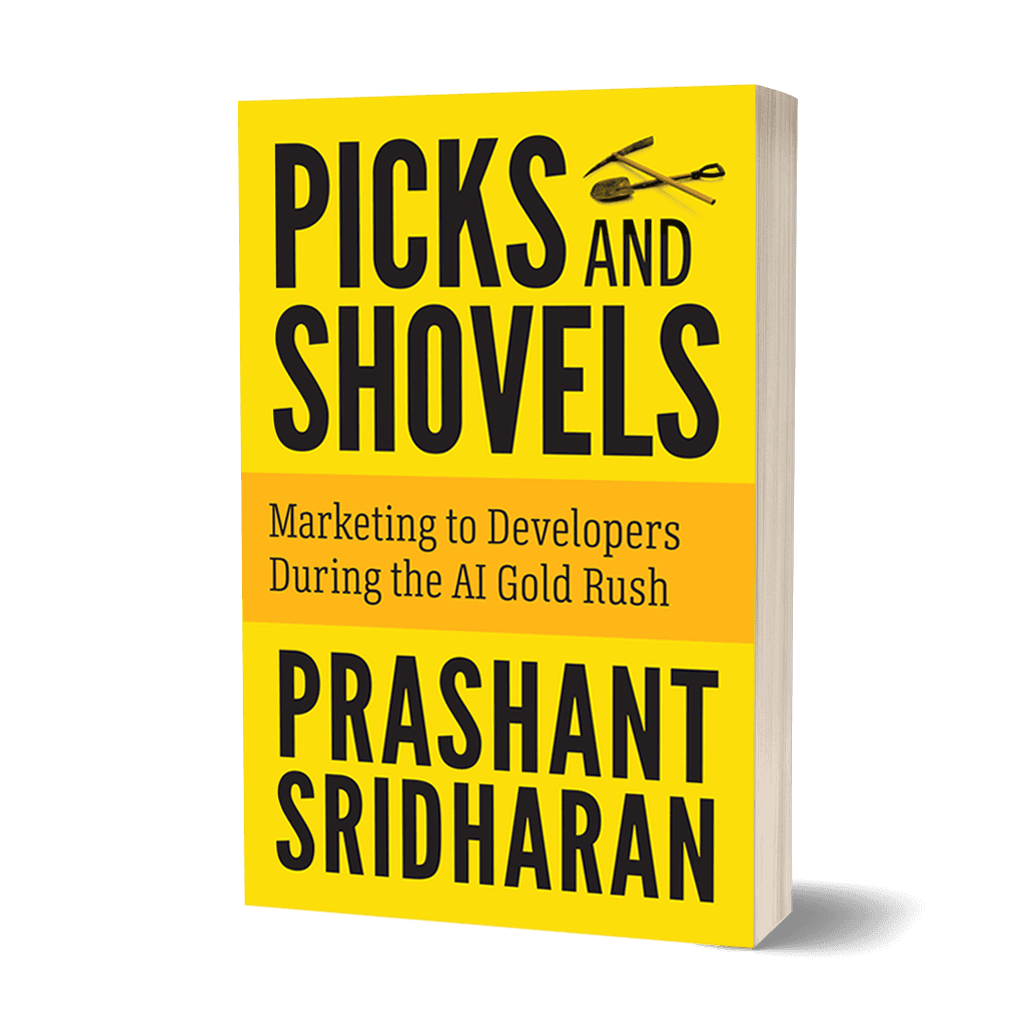
I cover these principles and many more in Picks and Shovels. The fundamentals of developer marketing have not changed just because the features have AI in them. Developers still want to know what your product does, how it works, whether they can trust it, and what it costs. Answer those questions with specificity and you will earn their attention. Answer them with buzzwords and you will earn their contempt.

Developer marketing expert with 30+ years of experience at Sun Microsystems, Microsoft, AWS, Meta, Twitter, and Supabase. Author of Picks and Shovels, the Amazon #1 bestseller on developer marketing.
Want the complete playbook?
Picks and Shovels is the definitive guide to developer marketing. Amazon #1 bestseller with practical strategies from 30 years of marketing to developers.