If Picks and Shovels had one more chapter
I published the book in 2025. The chapter I would add now is about marketing to agents, and the part I got wrong is more interesting than the part I would add.

Picks and Shovels is the definitive book for technical marketing and developer marketing. It was an Amazon bestseller, but there's one chapter that, looking back on it, I would add now, after 12 months in the market. The chapter is about marketing to agents as a distinct audience that evaluates, compares, and recommends on someone else's behalf. That is a different thing from marketing with AI, which is using a model to write copy. The chapter couldn't make it into the book because the concept of agents didn't exist when the book went to print.
I'm able to write that chapter for you now.
Agents aren't just server processes. Anthropic defines an agent as a system where the model directs its own process and its own tool use, deciding how to accomplish a task instead of following a path somebody wrote in advance. A script runs the steps you gave it. An agent picks the steps. That difference is the whole thing for marketers, because you cannot predict which pages it will read or in what order.
They are already inside the buying process. G2 surveyed a thousand software buyers this past March and found that just over half now start in a chatbot rather than a search engine, up from under a third a year earlier. More than two thirds said they ended up choosing a different vendor than the one they walked in planning to buy. I cover how to measure both recommendations and agent actions in Marketing to machines.
How people use agents to evaluate products
Agents may not be sitting at the table next to your finance team, but they are doing the hard work of evaluating products and determining which ones make the cut. At our company, we have a "three bids and a buy" process. You start with one or two products you really like, and then you research a third or maybe a fourth to compare them to.
The comparison involves product features, onboarding, the complexity of the licensing model, and pricing.
That initial comparison is increasingly being done by agents. Recently, I was shopping for new webinar software. Almost every webinar tool on the market is absolutely horrific. Some products like GoToWebinar are terrible, and others like Riverside are massively overpriced. Finding the sweet spot is complicated.
Enter my agent.
I asked ChatGPT, and then later I asked Claude, to go do some research on all webinar tools, and then I set forth the criteria that I had.
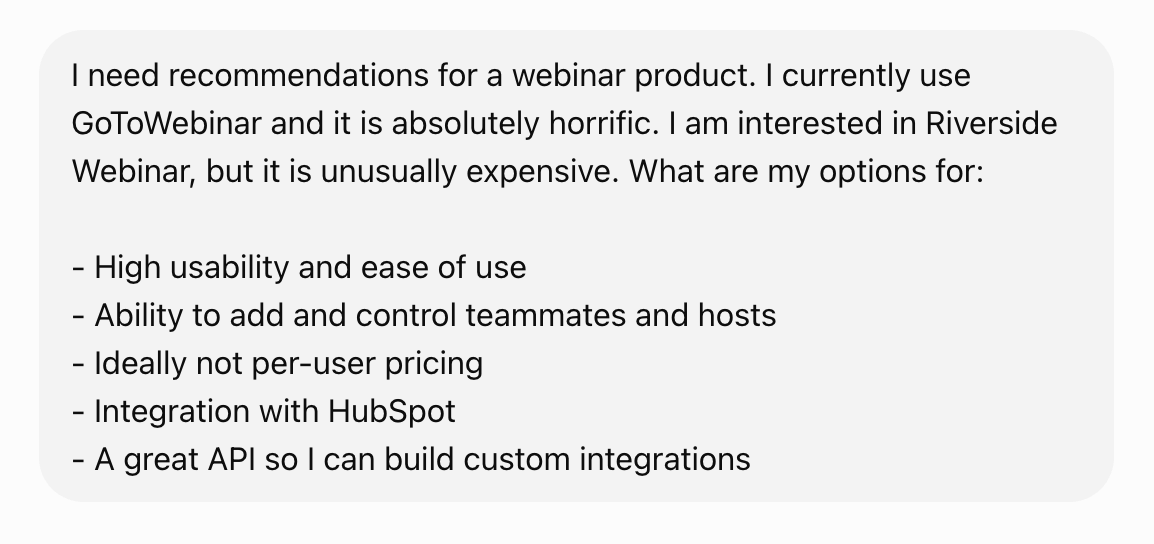
The result was a list of five or six webinar tools, four of which I had already considered.
ChatGPT and Claude saved me several hours of clicking around the internet and searching Google. You already know that part. We do it every day. But I stopped. I didn't do any more searching. I accepted that the tools it recommended were the best options based on my criteria.
The pricing page has a reader who cannot see
Part of this analysis is having the agent research pricing.
Now it's commonplace for B2B SaaS companies to hide pricing from customers. The idea is that if someone is qualified enough, they'll reach out and talk to a salesperson, who will escort them through the product and the pricing model. It was asinine then, and it's even more asinine now.
If your pricing page is not open to agents, they won't even consider you. If you're stuck in the old B2B SaaS model of "talk to sales" and not offering pricing on your website, you're screwed.
I really admire Resend, the email sending company for developers. Recently, they redid their entire pricing page to be visible to agents as markdown. And now even I, an already converted user, can ask my agent to model how much Resend is going to cost me when I deploy one of my applications.
Let the agents have access to your data, especially your pricing data.
Set up structured markup for your pricing page
Make sure that you are following best practices and your pricing is marked up in JSON-LD. JSON-LD is a structured data format that is designed to be easy for machines to parse. It's a great way to make your pricing page easy for agents to understand.
Here is a complete example for a fictitious database:
{
  "@context": "https://schema.org",
  "@type": "SoftwareApplication",
  "name": "AcmeDB",
  "applicationCategory": "DeveloperApplication",
  "operatingSystem": "Cloud",
  "offers": [
    {
      "@type": "Offer",
      "name": "Free",
      "price": 0,
      "priceCurrency": "USD",
      "priceSpecification": {
        "@type": "UnitPriceSpecification",
        "price": 0,
        "billingDuration": "P1M"
      },
      "eligibleQuantity": {
        "@type": "QuantitativeValue",
        "name": "API calls",
        "maxValue": 100000,
        "unitText": "per month"
      },
      "additionalProperty": [
        { "@type": "PropertyValue", "name": "Storage", "value": "1 GB" },
        { "@type": "PropertyValue", "name": "Connections", "value": "5" },
        { "@type": "PropertyValue", "name": "Support", "value": "Community forums" },
        { "@type": "PropertyValue", "name": "Regions", "value": "1" }
      ]
    },
    {
      "@type": "Offer",
      "name": "Pro",
      "price": 49,
      "priceCurrency": "USD",
      "priceSpecification": {
        "@type": "UnitPriceSpecification",
        "price": 49,
        "billingDuration": "P1M"
      },
      "eligibleQuantity": {
        "@type": "QuantitativeValue",
        "name": "API calls",
        "maxValue": 10000000,
        "unitText": "per month"
      },
      "additionalProperty": [
        { "@type": "PropertyValue", "name": "Storage", "value": "50 GB" },
        { "@type": "PropertyValue", "name": "Connections", "value": "100" },
        { "@type": "PropertyValue", "name": "Support", "value": "Email, 24-hour response" },
        { "@type": "PropertyValue", "name": "Regions", "value": "3" }
      ]
    },
    {
      "@type": "Offer",
      "name": "Enterprise",
      "price": 399,
      "priceCurrency": "USD",
      "priceSpecification": {
        "@type": "UnitPriceSpecification",
        "price": 399,
        "billingDuration": "P1M"
      },
      "eligibleQuantity": {
        "@type": "QuantitativeValue",
        "name": "API calls",
        "maxValue": 500000000,
        "unitText": "per month"
      },
      "additionalProperty": [
        { "@type": "PropertyValue", "name": "Storage", "value": "1 TB" },
        { "@type": "PropertyValue", "name": "Connections", "value": "Unlimited" },
        { "@type": "PropertyValue", "name": "Support", "value": "Dedicated Slack channel, 1-hour response" },
        { "@type": "PropertyValue", "name": "Regions", "value": "All available" },
        { "@type": "PropertyValue", "name": "SSO", "value": "SAML, OIDC" }
      ]
    }
  ]
}
In milliseconds, the agent can glean the pricing tiers and the levers that go into pricing, and compute an actual price based on either parameters that you supply or an analysis of your code base.
Documentation is the storefront now
Another aspect of optimizing for agents is making sure that your documentation is complete and easy for them to read. In the old days, your home page used to be the front door: a developer would Google your product name and land on your site and then explore. Now, if a developer goes to ChatGPT or Claude and says, "Find me products," the most important page is your documentation.
You're inside Claude, you're coding, and you ask Claude, "Hey, give me a tool to be able to send transactional emails from my application." Claude will go out, it will evaluate a number of tools, it will learn what their capabilities are, it will compare those capabilities to what you're trying to build, and then it'll match you to the best possible outcome.
Your documentation needs to be machine-readable for this to happen. Markdown alongside the regular documentation. Make sure your API reference is well documented. Include scenario-based documentation with code samples so that the agents can infer how to use the product most effectively. And most important, do not gate your documentation behind signup.
Another thing that I'd like to experiment with is hidden documentation. It's documentation that's visible in the sitemap but not in the header or the footer. Normal users can still access it if they have the URL, but it's intended for agents. Consider putting knowledge bases and anything else that would clutter your documentation into the sitemap and hiding them from the header and footer. Let the agents have access to this information and do with it as they need.
Trust is the part you cannot fake
The other thing about agents is that they audit trust by cross-referencing everything. They don't just read your docs. They weigh what your community is saying online. They weigh what's going on in GitHub activity. They even weigh Stack Overflow discussions, or what's left of them. They look into Reddit threads. They look into Hacker News comments. They look into Discord conversations that are available publicly. They even look at third-party review sites. Agents pull all this information together and synthesize it to form an opinion about how trusted you are.
You can't control this entire narrative. You can only earn it.
This is another reason why community is so important, even to this day. Because of how agents collate and synthesize information, what your community is saying about you may carry more weight than what you say about yourself.
What it means for the next edition
So much of Picks and Shovels is focused on the fundamentals of marketing and specifically how people relate to other people. Marketing is at its core about communication.
Now there's a new party to our communication channels.
It's important for all of us as marketers to understand what agents can do, how they process information, and how they synthesize and present it to their users.
It's only going to get more difficult because today agents tend to speak directly to users, but soon it will be common for agents to speak to other agents. There will be chains of agents that send information to one another, and it will become nearly impossible to debug the output that's presented to users.
It is in your best interest to start now and understand how to make your marketing communicate with agents effectively. Your website most of all, but almost all of your marketing.
The question I ask myself is: Should I write a second edition for this book? The answer is probably absolutely not. The core message of the book remains salient, but by the time I write a chapter on talking to agents, the entire industry will have changed.
Let's wing it together.

Developer marketing expert with 30+ years at Sun Microsystems, Microsoft, AWS, Meta, Twitter, and Supabase. Author of Picks and Shovels, the Amazon #1 bestseller on developer marketing.