The dark funnel ate your developer marketing attribution
Developer marketing attribution was already unreliable before AI. Now most of the buying journey happens in AI tools and communities your dashboard will never see. That slice is shrinking fast.

Your developer marketing dashboard is still accurate, and that is the problem. It measures a shrinking minority of what actually drives buying decisions. The traffic numbers are correct. The conversion rates are correct. The attribution model is doing exactly what it was designed to do. But it was designed for a world where buyers touched your web properties before they made up their minds, and that world is ending.
Conductor's 2026 AEO/GEO Benchmarks Report analyzed 3.3 billion sessions across more than 13,000 domains and found 93% of Google AI Mode sessions end without a click to an external website. Wynter's January 2026 survey of 101 B2B SaaS CMOs found 68% now start their vendor research in AI tools like ChatGPT, Claude, and Perplexity before traditional search. AI usage for vendor discovery jumped from 24% to 84% in twelve months. The research phase of the buying journey moved, and your analytics stayed right where it was.
Developer marketing attribution was already unreliable before any of this happened. I wrote in how to measure developer marketing ROI that "influence often happens offline in communities and private conversations your analytics will never see." That was true in 2024. In 2026, offline influence has stopped being a footnote to the measured funnel and become most of the funnel itself.
What is the dark funnel in developer marketing?
Picture every step a developer takes before they buy that never lands in your reports: a peer recommendation in Slack, a Reddit thread, a Discord server, a hallway conversation at a conference, and now a research session inside ChatGPT, Claude, or Perplexity. These channels drive developer buying decisions, and none of them generate trackable signals in your dashboard. The term was coined by B2B marketers who noticed that their pipeline was growing faster than their traceable marketing activity could explain. Developer marketers have lived with this problem longer than most, because developers were doing peer-to-peer recommendation at scale before it became a B2B talking point.
The original dark funnel was manageable because most buyers still touched your website before making a decision. The community conversation built the shortlist. The Google search surfaced your page. The website visit generated the signal. Attribution credited the last click and everyone went home.
The whole sequence falls apart now. The shortlist gets built inside an AI tool. The buyer types your name directly into the browser after the AI recommended it, or skips the vendor site entirely and asks the AI for a pricing summary. The "last touch" your analytics records is "direct traffic" or "organic search," and the actual influence, the AI conversation that surfaced your name, is invisible.
Brian Curry's analysis of the AI dark funnel in March 2026 put it bluntly: "every stage of the customer journey that unfolds inside AI-powered conversations leaves zero attributable signals." AI tools have no UTM parameters to pass, no cookies to set, and no referral traffic to generate back to the vendors they recommend. There is no browser extension you can install to fix this, because the signal was never there to capture in the first place.
Why are attribution frameworks failing for developer marketing?
Every major model, first touch, last touch, multi-touch, and marketing-influenced, needs the buyer to leave a trackable signal somewhere on a property you control. When the research phase moves into channels that generate no signals, the model keeps measuring accurately, but only the slice of the journey that stayed visible. The problem lives in how attribution is built, so a better tool will not fix it.
The gap between what the dashboard measures and what actually drives buying decisions is old news. SparkToro and other research firms have run annual studies comparing CRM-tracked attribution to buyer self-reports for years, and the gaps have been consistent. Buyers say they heard about a product through a colleague recommendation or a community thread. Analytics credits a Google search or an email click. The dashboard and the buyer cannot both be right, and the buyer is usually closer to the truth about what actually influenced the decision.
Developer marketing is worse than average on this dimension because developers trust peer-to-peer signals more than most buyers. A 2024 Reddit thread recommending a database tool for real-time analytics can drive conversions in 2026. I wrote about this pattern in Reddit is walling off the last honest channel: r/ExperiencedDevs has more than 321,000 members who search Reddit before they search vendor sites. The conversion that eventually shows up looks like organic search. The actual influence was a forum thread from two years ago that no analytics tool ever touched.
AI intermediation did not invent this behavior. It pushed even more of it into channels that generate no signals. The existing dark funnel absorbed the research phase entirely. The buyer who used to skim three vendor homepages and then ask a friend on Slack now asks Claude first, gets a shortlist, reads the top Reddit thread Claude cited, and then goes directly to the vendor's pricing page. The vendor sees a direct-traffic visit that converts. The five touchpoints that actually mattered are all invisible.
How much of the buying journey is now invisible?
Add up the data and only a thin sliver of the developer buying journey still shows up in your tools. Conductor's analysis pegs 93% of Google AI Mode sessions as zero-click compared to 34% for traditional Google Search. Wynter's data shows 68% of B2B SaaS buyers start in AI before Google. On top of that, when you ask buyers how they found a product, their answers routinely clash with what the analytics credits, often by a wide margin. These numbers do not average out to a clean percentage, but they point in the same direction: the measurable slice is shrinking, fast.
AI agents are also starting to do procurement work directly. I wrote in if Picks and Shovels had one more chapter that AI agents are reading documentation, evaluating pricing pages, and building shortlists on behalf of their users. When a procurement team's AI agent screens five database vendors, it may visit your pricing page and your competitor's, generate a bounce in your analytics, and produce a recommendation that never appears in your CRM until the deal closes weeks later. A real research session ran through your product, and your analytics logged a single unexplained bounce.
The 10-touchpoint rule for developer marketing breaks under this pressure because most of the touchpoints are now unearnable through tracked channels. There is no campaign you can run to earn an AI recommendation, no retargeting pixel that reaches a Reddit thread, and no A/B test that changes the conversation happening in a private Discord server. The work that drives those touchpoints still matters. The dashboard simply cannot see it.
What should developer marketers measure instead?
Stop chasing clean credit for every conversion and start tracking how much you influence the decision. Influence measurement asks whether your product shows up where developer decisions actually form: AI tool recommendations, relevant subreddits, Discord and Slack communities, and the third-party content AI tools cite when they answer category questions. Run these signals alongside your click-based analytics, where they fill in the channels the dashboard cannot see.
There are four categories of influence measurement that matter for developer marketing in 2026.
-
AI recommendation share. Run prompts across ChatGPT, Claude, Perplexity, and Gemini monthly. Ask "what is the best X for Y" where X is your category and Y is your ideal customer's use case. Track whether you show up, in what position, and with what framing. This is imperfect. Rand Fishkin's research shows AI outputs are inconsistent between runs. Treat it as a directional signal, not a scoreboard.
-
Community presence. Track mention rate in the subreddits, Discord servers, and Slack communities where your audience actually talks. If your category has a few canonical forums, a simple monthly count of mentions and the sentiment around them is more useful than any CRM report. The work takes real hours, and it is worth every one of them.
-
Self-reported attribution surveys. Ask your own customers how they first heard about you, with free-text answers. The answers will contradict your analytics. They will also be closer to the truth. Keep the data over time. The patterns matter more than any single quarter.
-
AI-friendly content presence. I wrote in making your content AI-friendly in 2026 that AI tools cite specific kinds of content more than others. If your documentation, blog posts, and solution pages show up in AI answers, you are in the recommendation set. If they do not, you are invisible regardless of how good your product is.
None of these replace your dashboard. Keep measuring paid channels, campaign performance, and conversion rates where the signals exist. The mistake is treating the dashboard as the full picture. The full picture is the dashboard plus everything the dashboard cannot see, and the second half is now bigger than the first.
The deeper shift is that measurement has to stop being about credit and start being about presence. The old question was "what marketing activity caused this conversion?" The new question is "where does my product need to show up for developers to consider it at all?" The first question has mostly unanswerable answers. The second question is answerable if you look in the right places, and the right places are mostly not inside your analytics.
For more on measurement and the state of developer marketing, visit the Developer Marketing Hub.

Developer marketing expert with 30+ years of experience at Sun Microsystems, Microsoft, AWS, Meta, Twitter, and Supabase. Author of Picks and Shovels, the Amazon #1 bestseller on developer marketing.
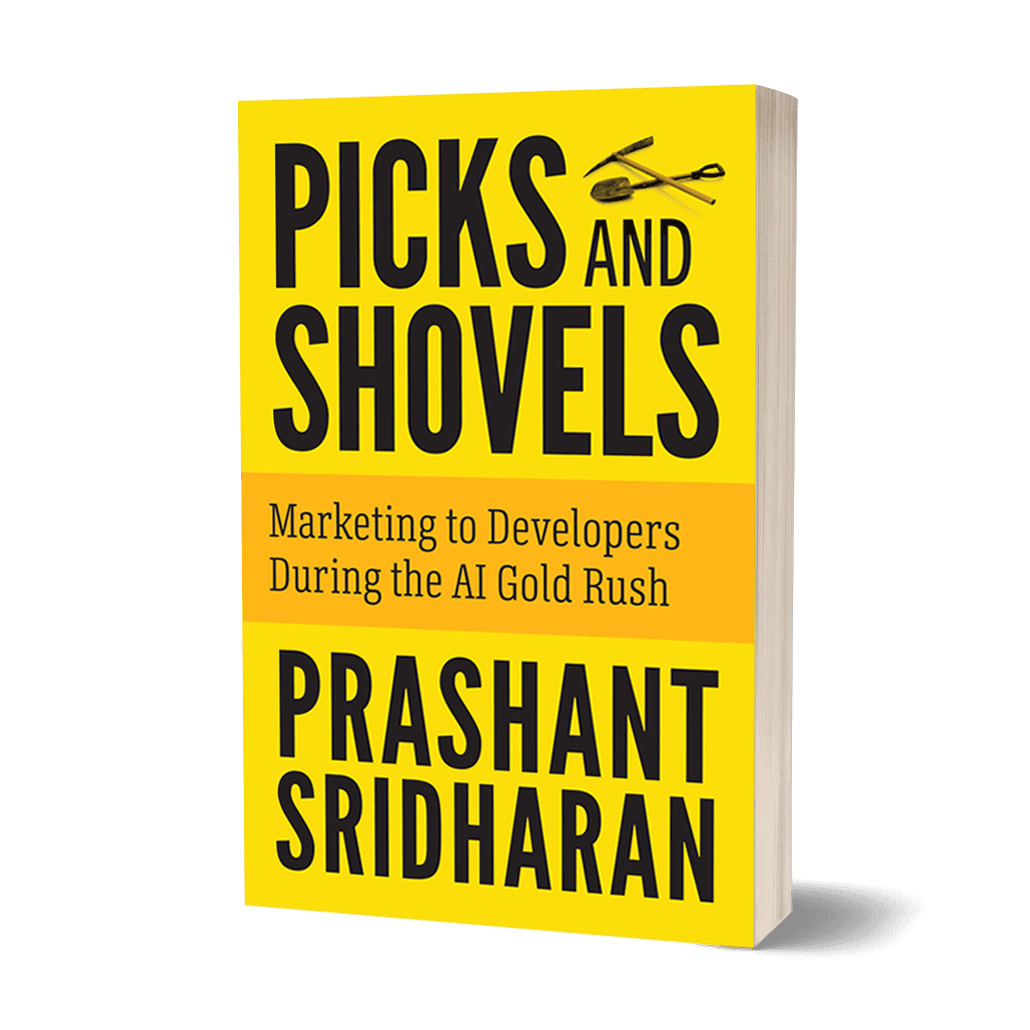
Want the complete playbook?
Picks and Shovels is the definitive guide to developer marketing. Amazon #1 bestseller with practical strategies from 30 years of marketing to developers.