Segment
SEG-ment
A group of customers or prospects that share common characteristics. How you divide the market into targetable groups.
A segment is a group of customers or prospects that share characteristics relevant to how you sell to them. You can segment by company size (SMB, mid-market, enterprise), industry (fintech, healthcare, e-commerce), use case (monitoring, deployment, security), or behavior (self-serve adopters, sales-assisted buyers).
Segmentation drives everything. Different segments need different pricing, different sales motions, different marketing messages, and sometimes different products. Selling to a 10-person startup and a 10,000-person bank requires completely different approaches. Pretending they are the same customer is how you fail at both.
The most useful segmentation is the one that predicts buying behavior. If companies with 100+ developers close at 3x the rate of companies with fewer than 50 developers, engineering team size is a powerful segmentation variable. Find the characteristics that predict conversion, retention, and expansion.
Examples
A company segments by company size.
SMB (1-50 employees): self-serve, $99-499/month. Mid-market (50-500 employees): sales-assisted, $10k-50k/year. Enterprise (500+ employees): field sales, $100k+/year. Each segment has its own pricing page, sales team, and marketing campaigns.
Segmentation reveals a hidden opportunity.
The company segments customers by industry and discovers that fintech companies have 2x the retention rate and 3x the expansion rate of other industries. They launch an industry-specific campaign and hire an AE with fintech experience.
Over-segmentation creates complexity.
The marketing team creates 12 segments with unique messaging for each. The content team cannot produce enough material. The sales team cannot remember which pitch is for which segment. They simplify to 4 segments and execution improves.
In practice
Read more on the blog
Frequently asked questions
What is the best way to segment a B2B market?
Start with the variable that best predicts buying behavior: company size, industry, tech stack, or use case. Test by checking whether conversion rates, deal sizes, and retention rates differ meaningfully across segments. If they do, you have a useful segmentation.
How many segments should a company have?
Three to five for most B2B companies. Fewer than three and you miss important differences. More than five and you cannot execute distinct strategies for each. Start simple and add segments only when data shows they behave differently enough to justify separate treatment.
Related terms
A description of the company (not person) most likely to buy, succeed, and expand with your product. Your best-fit customer.
A semi-fictional representation of the individual buyer or user. Describes their role, goals, pain points, and decision-making process.
How you define what your product is, who it is for, and why it is different from alternatives. The foundation of every marketing decision.
The total revenue opportunity if you captured 100% of the market. The theoretical ceiling, not a realistic target.
Want the complete playbook?
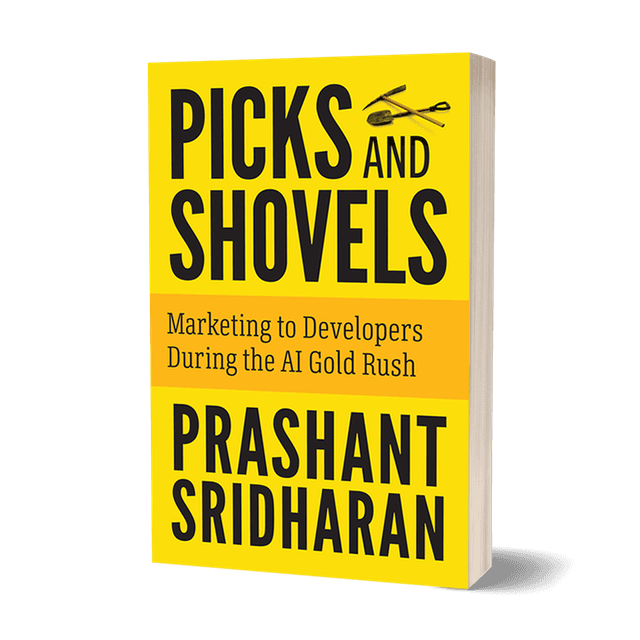
Picks and Shovels is the definitive guide to developer marketing. Amazon #1 bestseller with practical strategies from 30 years of marketing to developers.