Seed round
seed rownd
The first significant round of funding for a startup, typically raising $1-5M to validate the product and find initial customers.
A seed round is the first significant fundraise for a startup. It comes after the founders have an idea, maybe a prototype, and need capital to build the product and find early customers. Seed rounds typically range from $1M to $5M, though the range has widened in recent years.
Seed investors are betting on the team and the market more than the product. At seed stage, the product might be a prototype or an MVP. Revenue is usually minimal or zero. The pitch deck is about the problem, the market size, and why this team is uniquely positioned to solve it.
Seed capital funds the company for 12-18 months, enough time to build the product, find product-market fit, and demonstrate enough traction to raise a Series A. Most seed rounds use SAFE notes or convertible notes rather than priced equity.
Examples
A two-person startup raises a seed round.
The founders have an MVP and 10 beta customers. They raise $3M from two VC firms and three angel investors. The capital funds 18 months of development: hiring 5 engineers, building the product, and acquiring the first 100 paying customers.
A seed round sets the valuation.
The founders raise $2.5M at a $10M pre-money valuation. After the round, the company is worth $12.5M (post-money). The investors own 20% of the company ($2.5M / $12.5M). The founders and early employees own the remaining 80%.
A seed-stage company uses the capital to find PMF.
The team spends the first 6 months talking to 200 potential customers, building and iterating the product based on feedback, and running through three significant pivots before finding a market that pulls the product forward.
In practice
Read more on the blog
Frequently asked questions
How much should a startup raise in a seed round?
Enough to fund 18-24 months of runway at your planned burn rate. For most software startups, that is $1.5M to $4M. Raise enough to reach clear milestones (PMF, $1M ARR) that make the Series A raise possible.
What do seed investors look for?
The team (relevant experience, technical ability, coachability), the market (large and growing), the insight (why now, why this approach), and early signal (waitlist signups, LOIs, pilot customers). Product and revenue matter less at seed than at later stages.
Related terms
The earliest stage of startup funding, typically $100K-$1M from angels or small funds to build the initial prototype.
The first major institutional funding round, typically $5-20M, raised after a startup demonstrates product-market fit and initial traction.
The estimated worth of a company, determined during a funding round by negotiation between founders and investors.
A high-net-worth individual who invests their personal money in early-stage startups in exchange for equity.
A simple investment instrument created by Y Combinator that converts to equity at the next priced funding round.
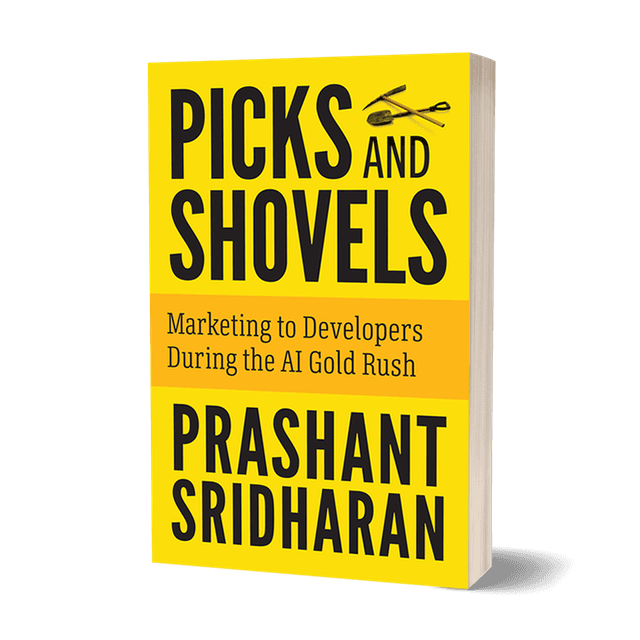
Want the complete playbook?
Picks and Shovels is the definitive guide to developer marketing. Amazon #1 bestseller with practical strategies from 30 years of marketing to developers.