Sales efficiency
saylz eh-FISH-en-see
How much revenue you generate per dollar spent on sales and marketing. A measure of whether your go-to-market engine is working.
Sales efficiency measures the return on your go-to-market investment. The simplest version: new ARR divided by total sales and marketing spend. If you spend $2M on sales and marketing and generate $3M in new ARR, your sales efficiency is 1.5. For every dollar spent, you created $1.50 in recurring revenue.
This is closely related to the magic number, which uses a one-quarter lag. Sales efficiency can be calculated with or without a lag, depending on your sales cycle. Short sales cycles (self-serve, PLG) need less lag. Long enterprise cycles need more.
Sales efficiency should improve over time. Early-stage companies have low efficiency because they are building sales infrastructure (hiring, training, building playbooks). As the team ramps and playbooks mature, efficiency should rise. If efficiency stays flat or declines as you grow, your go-to-market motion has a structural problem.
Examples
Calculating sales efficiency.
Annual sales and marketing spend: $10M. Net new ARR added: $15M. Sales efficiency: 1.5. This means the company generates $1.50 in recurring revenue for every $1 spent on sales and marketing. At this efficiency, the investment pays back in under 12 months.
Sales efficiency declines with scale.
At $5M ARR, sales efficiency was 2.0 (mostly inbound, one AE). At $20M ARR, efficiency dropped to 0.8 (outbound team, SDR/AE pairs, events, paid ads). The easy customers have been acquired. Growth now requires more expensive channels. This is normal but must be managed.
Comparing sales efficiency across channels.
Self-serve channel: $200k in marketing spend generates $800k in new ARR. Efficiency: 4.0. Enterprise sales: $2M in sales team costs generates $3M in new ARR. Efficiency: 1.5. Self-serve is 2.7x more efficient, but enterprise generates larger deal sizes with lower churn.
In practice
Read more on the blog
Frequently asked questions
What is a good sales efficiency ratio?
Above 1.0 is the minimum. Between 1.0 and 1.5 is good. Above 1.5 is excellent. Below 0.5 means you are spending $2 to generate $1 of recurring revenue, which is unsustainable unless your retention and expansion are extraordinary.
How do I improve sales efficiency?
Four levers: increase deal sizes (pricing and packaging optimization), shorten sales cycles (better qualification and demos), improve lead quality (targeting and marketing alignment), and reduce customer acquisition cost (PLG, self-serve, content marketing). Work on one lever at a time and measure the impact.
Related terms
Net new ARR divided by sales and marketing spend from the prior quarter. Measures how efficiently you convert marketing dollars into recurring revenue.
The total cost of sales and marketing divided by the number of new customers acquired in a period.
The revenue and cost associated with a single customer. Profitable unit economics mean each customer generates more revenue than they cost to acquire and serve.
The annualized value of your active subscription contracts. The heartbeat metric of every SaaS business.
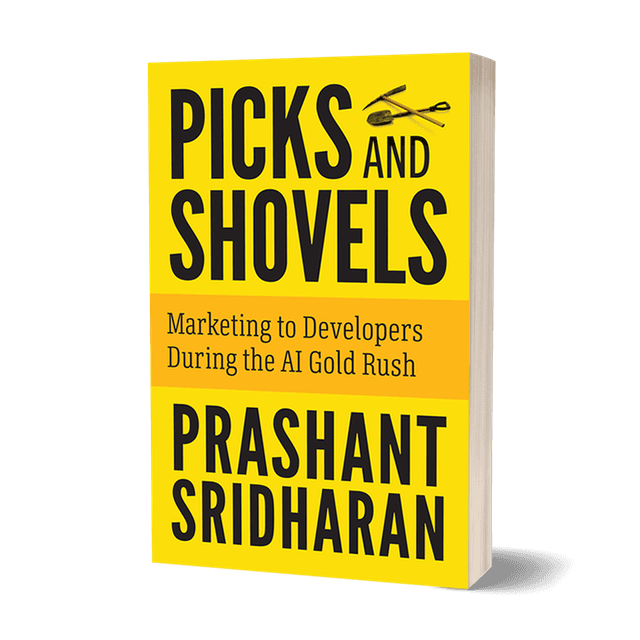
Want the complete playbook?
Picks and Shovels is the definitive guide to developer marketing. Amazon #1 bestseller with practical strategies from 30 years of marketing to developers.