Product-led sales
PROD-ukt led saylz
A sales approach where product usage data identifies and qualifies sales opportunities from self-serve users.
Product-led sales uses product usage data to identify and qualify sales opportunities. Instead of traditional lead scoring based on form fills and website visits, PLS scores accounts based on actual product behavior: how many team members are active, which features they use, and whether they are approaching plan limits.
This model sits between pure PLG (no sales team) and pure sales-led (no self-serve). Users start on their own. The product tracks engagement. When an account shows signals of enterprise readiness (multiple users, high usage, enterprise feature requests), a sales rep reaches out.
The conversion rates are dramatically higher than cold outreach. The user already knows the product. They already experience value. The sales rep is not pitching; they are helping the user solve a scaling problem.
Examples
A PLS system identifies a high-value account.
An account has 15 active users across 3 teams. They hit their API rate limit twice this week. Their usage pattern matches enterprise customers. A PQL (product-qualified lead) alert fires. The AE reaches out with a personalized message about the enterprise plan.
A company builds PLS scoring criteria.
Score +5 for each active user. Score +10 for inviting a team member. Score +20 for hitting a usage limit. Score +30 for viewing the enterprise pricing page. Accounts above 50 points are routed to sales. Accounts below are nurtured through the product.
A PLS rep converts a self-serve account to enterprise.
The account is paying $200/month on the team plan. The rep identifies that they have 25 users and growing. They offer the enterprise plan with SSO, audit logs, and priority support at $2,000/month. The customer upgrades because they need the enterprise features.
In practice
Read more on the blog
Frequently asked questions
How is product-led sales different from traditional sales?
Traditional sales starts with a cold prospect who may not know the product. PLS starts with an active user who already gets value from the product. The conversation is fundamentally different: 'Let me show you what this product does' versus 'Let me help you scale what you are already doing.'
What tools support product-led sales?
Product analytics (Amplitude, Mixpanel) to track usage signals. PQL platforms (Correlated, Pocus) to score and route accounts. CRM integration (Salesforce, HubSpot) for the sales team. The key is connecting product usage data to sales workflows.
Related terms
A go-to-market strategy where the product itself drives acquisition, conversion, and expansion through self-serve usage.
A hybrid go-to-market approach where a self-serve product is supplemented by sales engagement for larger or more complex deals.
A sales strategy where you start with a small deal or team and grow revenue within the account over time through expansion.
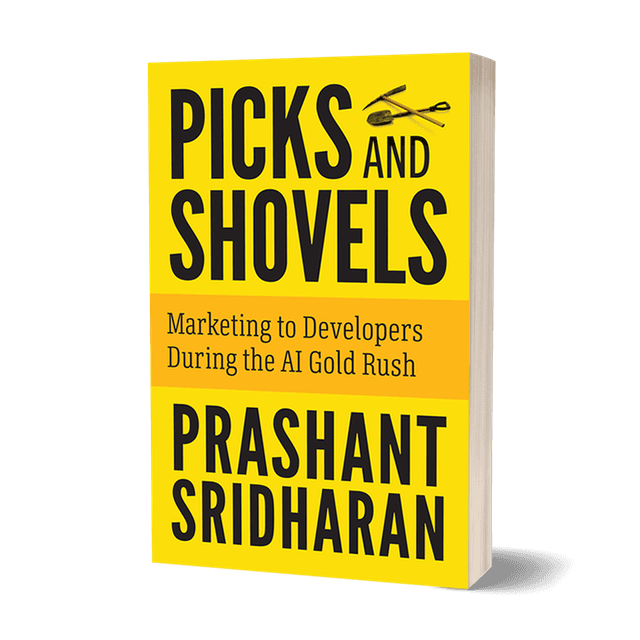
Want the complete playbook?
Picks and Shovels is the definitive guide to developer marketing. Amazon #1 bestseller with practical strategies from 30 years of marketing to developers.