Pivot
PIV-ut
A fundamental change in a startup's product, target market, or business model based on learnings from the current approach.
A pivot is a strategic change in direction. The startup keeps one foot planted (the team, the technology, or the market insight) and rotates to a new approach. It is not starting over. It is applying what you learned from Plan A to Plan B.
Famous pivots: Slack started as a gaming company. Instagram started as a check-in app called Burbn. YouTube started as a video dating site. In each case, the team noticed something working within their original product and pivoted to build around it. The goal is to find product-market fit before the money runs out.
The decision to pivot is one of the hardest in a startup. It means admitting that the current approach is not working. But the alternative, persisting with a failing approach because you have already invested time and money, is worse. The best pivots happen before the company runs out of runway. The lean startup methodology provides a framework for knowing when to pivot based on validated learning.
Examples
A B2C product pivots to B2B.
The consumer app has 10,000 users but cannot monetize. A few businesses start using it for internal communication. The team pivots: same core technology, different market. Revenue appears immediately. B2B was the right market all along.
A founder identifies a pivot opportunity from customer feedback.
Customers keep asking for a feature that is tangential to the core product. The feature gets more enthusiasm than the main product. The founder realizes the feature IS the product. They pivot to build a standalone product around that feature.
A startup pivots after running a failed experiment.
The team spent 6 months building an AI writing assistant. User testing shows people do not trust AI to write for them. But they love the AI research assistant features buried in the product. The team pivots from AI writing to AI research.
In practice
Read more on the blog
Frequently asked questions
When should a startup pivot?
When you have clear evidence that the current approach will not achieve product-market fit. Signs: consistently low retention, inability to find willing customers, negative unit economics with no path to improvement. Pivot before you run out of runway, not after.
How do you know if you need to pivot or just iterate?
Iteration means the core product and market are right but the execution needs improvement. Pivot means the product, market, or business model is fundamentally wrong. If small changes are not moving metrics, and you have tried multiple iterations, it might be time to pivot.
Related terms
The point where a product satisfies strong market demand, evidenced by organic growth and high user retention.
The simplest version of a product that can be released to test a hypothesis and learn from real user feedback.
How many months a startup can operate before running out of cash. Cash in the bank divided by monthly net burn.
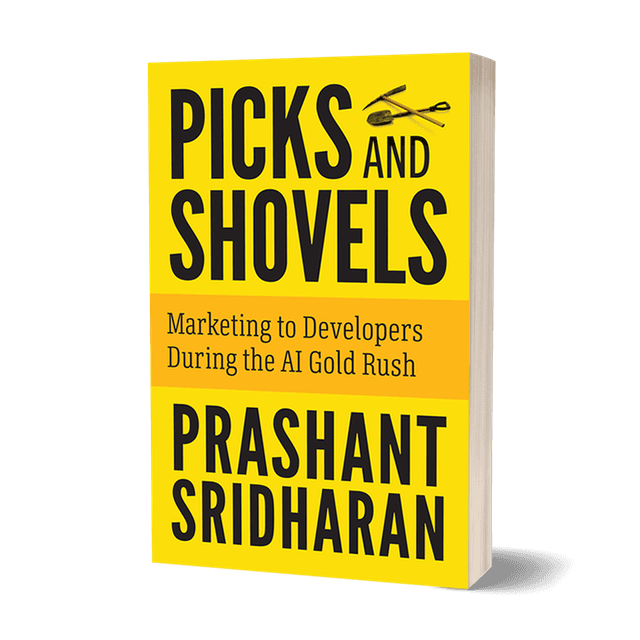
Want the complete playbook?
Picks and Shovels is the definitive guide to developer marketing. Amazon #1 bestseller with practical strategies from 30 years of marketing to developers.