Objection handling
ob-JEK-shun HAND-ling
Preparing responses to common prospect concerns: pricing, competition, risk, and implementation. Turning 'no' into 'tell me more.'
Objection handling is the practice of preparing responses to concerns that prospects raise during the sales cycle. Every product has common objections. 'Your price is too high.' 'We already use Competitor X.' 'We do not have the resources to implement.' 'What if it does not work?'
The goal is not to argue or overcome. It is to understand and address. The best responses acknowledge the objection, ask a clarifying question, and then reframe the conversation around value.
Document the top 10-15 objections your sales team hears. For each one, write: why the prospect says this, what they actually mean, a recommended response, and a proof point or customer story that addresses the concern. Share this as an enablement document and practice in role-play sessions.
Examples
Price objection handled with value framing.
Prospect: 'Your product costs 3x more than Competitor Y.' Rep: 'What is the cost of a deployment failure at your company?' Prospect: 'About $50k per incident.' Rep: 'Our customers see an 85% reduction in deployment failures. At 10 incidents per year, that is $425k in avoided costs. The product pays for itself in the first quarter.'
Competitor objection handled with positioning.
Prospect: 'We are already evaluating Competitor Z.' Rep: 'That makes sense. They are a good product for teams that have dedicated DevOps resources. Can I ask, does your team have a dedicated DevOps function, or do developers handle their own deployments?' This question highlights a differentiation point without attacking the competitor.
Risk objection handled with proof.
Prospect: 'What if the implementation fails?' Rep: 'Fair concern. Here is what we do differently: a dedicated implementation engineer, a 30-day success guarantee, and a phased rollout plan. Here is a reference from a company your size who went live in 10 days. Want to talk to them?'
In practice
Objection handling framework
ACKNOWLEDGE-QUESTION-REFRAME (AQR) METHOD

Step 1: ACKNOWLEDGE
"I hear you. That is a fair concern."
(Never dismiss or argue. Validate the prospect's perspective.)

Step 2: QUESTION
Ask a question that reveals the real concern behind the objection.
"When you say it is too expensive, are you comparing to your current solution, a competitor, or your budget for this quarter?"

Step 3: REFRAME
Reposition the conversation around value, not the objection.
"Most of our customers found that the cost of NOT solving this was 3-5x higher than the investment."

COMMON OBJECTIONS AND RESPONSES

"Your price is too high."
- Acknowledge: "I understand. Budget matters."
- Question: "What are you comparing it to? What does the status quo cost you per month?"
- Reframe: "Our average customer sees ROI within [X] months. Let me show you the math."

"We are happy with our current solution."
- Acknowledge: "That is great to hear."
- Question: "What made you take this meeting today?"
- Reframe: (Let their answer do the work.)

"We need to think about it."
- Acknowledge: "Of course."
- Question: "What specific concerns do you want to discuss internally? I may be able to address them now."
- Reframe: "Would it help if I sent a one-page summary for your team?"
Read more on the blog
Frequently asked questions
What are the most common B2B sales objections?
Price ('too expensive'), timing ('not a priority right now'), competition ('we already use X'), risk ('what if it does not work'), resources ('we do not have time to implement'), and authority ('I need to check with my boss'). Prepare responses for all six.
How do you train reps on objection handling?
Document the top 10 objections with recommended responses. Role-play regularly in team meetings. Record successful objection handling from real calls and share as examples. Update the objection document quarterly based on new patterns from win/loss analysis.
Related terms
Providing the sales team with the content, training, and tools they need to sell effectively. Bridging the gap between marketing and revenue.
A one-page competitive reference for sales reps. Covers a competitor's strengths, weaknesses, and how to win against them.
The first structured sales conversation where a rep qualifies the prospect by understanding their problem, timeline, and buying process.
The average time from first contact with a prospect to closed-won deal. Longer for enterprise, shorter for self-serve.
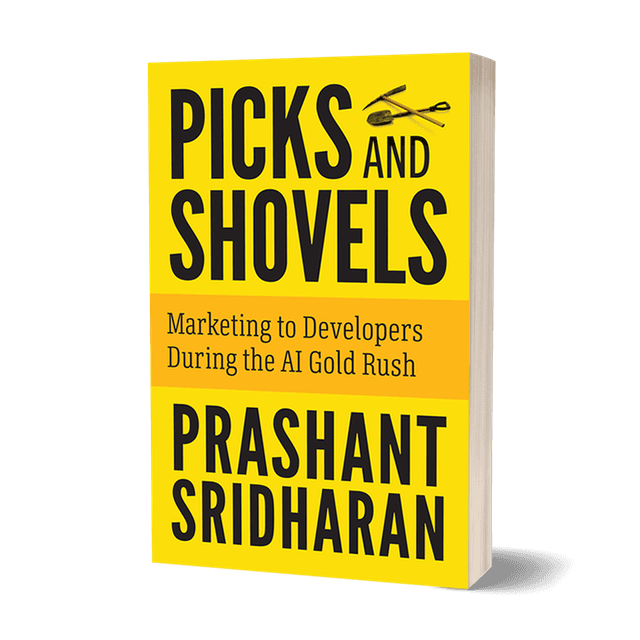
Want the complete playbook?
Picks and Shovels is the definitive guide to developer marketing. Amazon #1 bestseller with practical strategies from 30 years of marketing to developers.