Large language model
larj LANG-gwij MOD-ul
A neural network trained on massive text data to generate and understand language. The technology behind ChatGPT, Claude, and Gemini.
An LLM is a neural network trained on billions of pages of text. It learns patterns in language: grammar, facts, reasoning, style. Then it generates new text by predicting what comes next, one token at a time. GPT-4, Claude, Gemini, Llama. These are all LLMs.
The "large" part matters. GPT-3 had 175 billion parameters. GPT-4 is rumored to have over a trillion. More parameters means more capacity to learn patterns. But size alone is not enough. Training data quality, fine-tuning techniques, and alignment methods all determine whether a model is actually useful or just large.
For marketers, LLMs changed everything. They read your content. They summarize your documentation. They recommend your product, or your competitor's product, based on what they learned during training. If your content is not in the training data, you do not exist in the AI layer. AI engine optimization is how you fix that.
Examples
A developer asks an LLM for a database recommendation.
They type "What is the best database for a real-time analytics app?" into Claude. The model responds based on patterns from its training data. If your database product had strong documentation and community content in that training set, you get mentioned. If not, you are invisible.
A company uses an LLM for customer support.
Stripe uses LLMs to power support assistants that can answer billing questions, explain API errors, and walk developers through integration issues. The model was fine-tuned on Stripe's own documentation and support history.
An enterprise evaluates LLM providers.
The CTO compares OpenAI's GPT-4o, Anthropic's Claude, and Google's Gemini. GPT-4o has the largest ecosystem. Claude scores highest on safety and long-context tasks. Gemini integrates tightest with Google Cloud. The choice depends on the use case.
In practice
Read more on the blog
Frequently asked questions
What is the difference between an LLM and AI?
AI is the broad field. LLMs are a specific type of AI model trained on text. Not all AI is an LLM. Computer vision models, recommendation engines, and robotics systems are all AI but not LLMs. When people say "AI" in 2026, they usually mean LLMs, but the terms are not interchangeable.
Related terms
A large AI model trained on broad data that can be adapted for many tasks. The base layer companies like OpenAI and Anthropic build.
The smallest unit of text an LLM processes. Roughly 4 characters or 3/4 of a word. Tokens determine cost and context limits.
The maximum amount of text an LLM can process in a single request. Measured in tokens. Bigger windows handle more information at once.
Training an existing model on your specific data to improve its performance on your tasks. Customization without building from scratch.
When an AI model generates confident but factually incorrect output. It sounds right. It reads well. It is wrong.
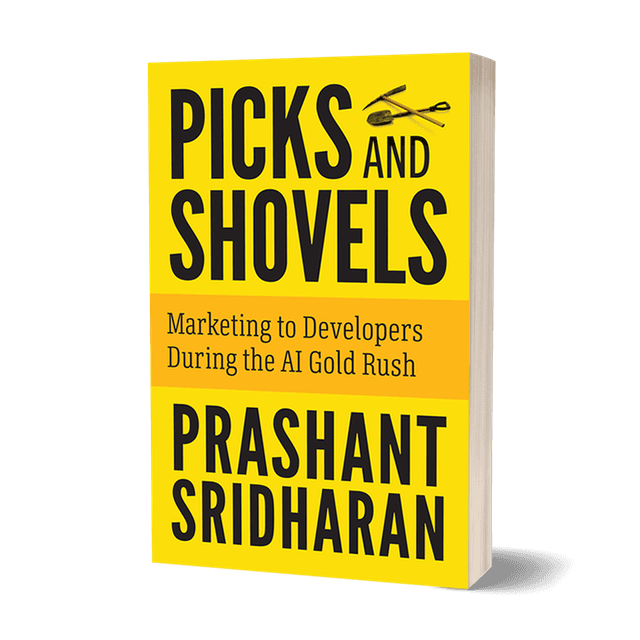
Want the complete playbook?
Picks and Shovels is the definitive guide to developer marketing. Amazon #1 bestseller with practical strategies from 30 years of marketing to developers.