Differentiation
dif-uh-ren-shee-AY-shun
What makes your product meaningfully different from alternatives. Not features. The reason a customer chooses you over everything else.
Differentiation is the answer to 'Why you instead of them?' It is not a feature list. It is the foundation of strong positioning. It is the specific, meaningful difference that makes your product the best choice for your target customer.
True differentiation is hard to copy. A feature can be copied in months. A superior developer experience built over years cannot. A community of practitioners cannot. A proprietary dataset cannot. Deep integration with a specific workflow cannot. These are durable advantages.
Many companies confuse features with differentiation. 'We have feature X' is not differentiation if the competitor ships feature X next month. 'We built the product specifically for teams that deploy 50+ times per day, and every design decision reflects that use case' is differentiation because it represents years of focused investment.
Examples
A developer tools company identifies real differentiation.
Not differentiation: 'We have a CLI.' (So does everyone.) Differentiation: 'We are the only platform that deploys to production in under 90 seconds because we pre-build and cache every dependency graph. That architecture took 2 years to build and requires deep integration with the build system.' That is hard to replicate.
Differentiation based on audience, not features.
Two monitoring tools have similar features. Tool A is built for DevOps teams. Tool B is built for developers who do not have a DevOps team. Same category, different differentiation. Tool B wins in companies without dedicated DevOps because every UX decision is designed for developers, not operators.
Differentiation erodes over time.
The company's initial differentiation was 'the only tool with real-time error tracking.' Two competitors ship the same feature. The company's new differentiation: 'the only platform that correlates errors with deployment events and automatically identifies the release that caused the regression.' More specific. Harder to copy.
In practice
Read more on the blog
Frequently asked questions
How do you find your differentiation?
Ask three questions. What do customers consistently cite as their reason for choosing you? What can you do that competitors cannot easily replicate? What unique perspective or approach does your product embody? The intersection of these three is your differentiation.
What if you do not have clear differentiation?
Then you compete on price, and competing on price is a race to the bottom. If your product is not meaningfully different, either find an underserved segment where your product is the best fit (differentiation through focus) or invest in building a genuine advantage that takes time to replicate.
Related terms
How you define what your product is, who it is for, and why it is different from alternatives. The foundation of every marketing decision.
How you differentiate your product from specific competitors. The answer to 'why should I choose you over them?'
A clear statement of the specific benefit your product delivers to a specific customer. The reason someone buys.
Defining an entirely new market category instead of competing in an existing one. High risk, high reward.
Want the complete playbook?
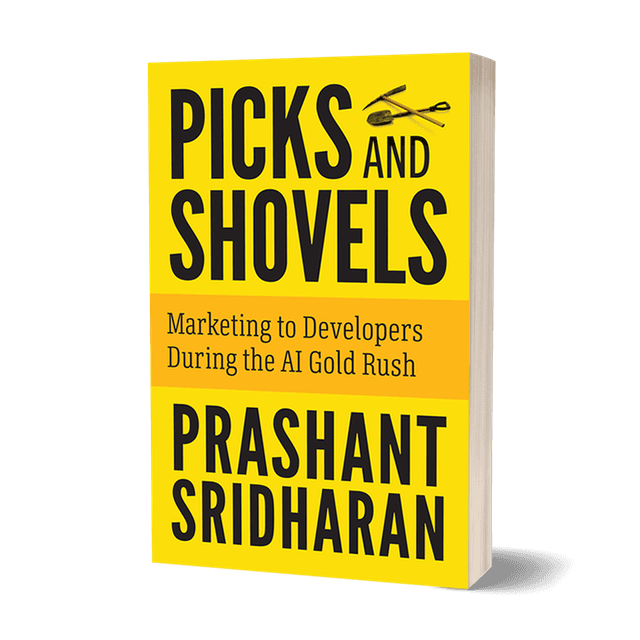
Picks and Shovels is the definitive guide to developer marketing. Amazon #1 bestseller with practical strategies from 30 years of marketing to developers.