Backlog
BAK-log
The prioritized list of all planned work that a team has not yet started.
The backlog is the prioritized list of all work a team intends to do: features, bugs, tech debt, improvements, and experiments. Items at the top are the highest priority and most likely to be worked on in the next sprint. Items at the bottom may never get done, and that is fine.
A healthy backlog is ruthlessly prioritized. The top 20 items are well-defined and ready to work on. The bottom 80% are rough ideas that may be deleted during the next grooming session. An unhealthy backlog has 500 items, no clear priority, and items that have been sitting untouched for two years.
Backlog grooming (or refinement) is the regular practice of reviewing, re-prioritizing, and pruning the backlog. Items that are no longer relevant get deleted. Items that need more detail get fleshed out. Items that have become urgent move up. Without regular grooming, backlogs become graveyards of good intentions.
Examples
A product manager prioritizes the backlog.
The backlog has 150 items. The PM spends an hour sorting the top 20 by business impact, marking 30 items in the middle as 'nice to have,' and deleting 40 items at the bottom that are outdated or no longer relevant. The team now knows exactly what to work on next.
A bug is added to the backlog.
A customer reports that exports fail for files over 100MB. The support team creates a backlog item with reproduction steps and customer impact. The PM triages it as high priority. It enters the next sprint as a P1 bug fix.
The backlog becomes unmanageable.
The team has 800 backlog items accumulated over three years. Nobody reads past item 30. The engineering manager declares 'backlog bankruptcy,' deletes everything older than six months, and starts fresh with only actively prioritized items. Nobody notices the deleted items were gone.
In practice
Read more on the blog
Frequently asked questions
How many items should be in a backlog?
The top 15-20 items should be well-defined and ready to work on. Beyond that, rough ideas are fine. If your backlog has more than 100 items, you are hoarding, not prioritizing. Regularly delete items that have been sitting untouched for more than 3-6 months.
What is the difference between a product backlog and a sprint backlog?
The product backlog is the full list of all planned work. The sprint backlog is the subset of items the team has committed to completing in the current sprint. The product backlog is managed by the product manager. The sprint backlog is managed by the development team.
Related terms
A fixed time period (usually 1-2 weeks) in which a team commits to completing specific work.
A meeting where the team selects which work to complete in the upcoming sprint and plans how to accomplish it.
A unit of measure for estimating the relative effort required to complete a work item in agile development.
The amount of work a team completes per sprint, measured in story points or similar units.
An Agile workflow method that visualizes work on a board and limits work in progress to improve flow and reduce bottlenecks.
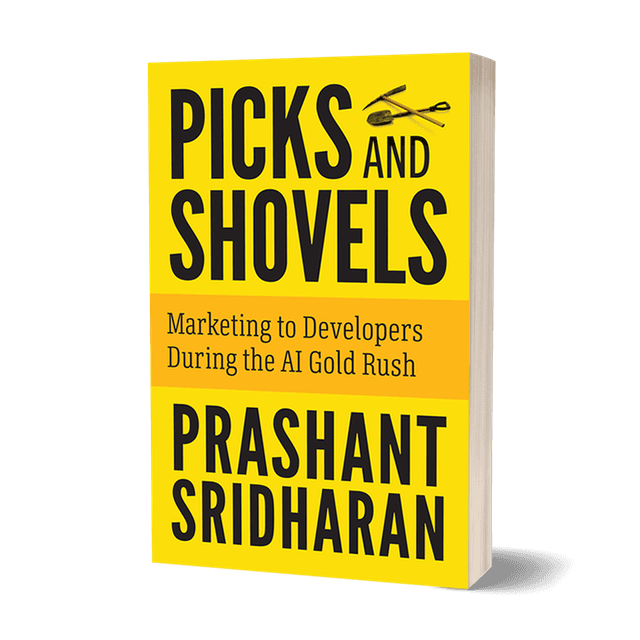
Want the complete playbook?
Picks and Shovels is the definitive guide to developer marketing. Amazon #1 bestseller with practical strategies from 30 years of marketing to developers.