The 5 best developer marketing books in 2026
A guide to the essential books for developer marketing and developer relations professionals. From foundational texts to the latest strategies for the AI era.

The five best developer marketing books in 2026 are Picks and Shovels, Developer Marketing Does Not Exist, Developer Relations by Caroline Lewko and James Parton, The Business Value of Developer Relations, and Developer Marketing and Relations by SlashData. Each one covers a different angle of the field, and together they form the closest thing we have to a curriculum.
If you're serious about developer marketing, you need to read. The field is still young enough that there's no established curriculum, no degree program, no certification. What we have instead are books written by practitioners who've learned through decades of trial and error.
I've read dozens of books on developer marketing, developer relations, and technical go-to-market strategy. These five are the ones I recommend to anyone entering the field or looking to level up their practice.
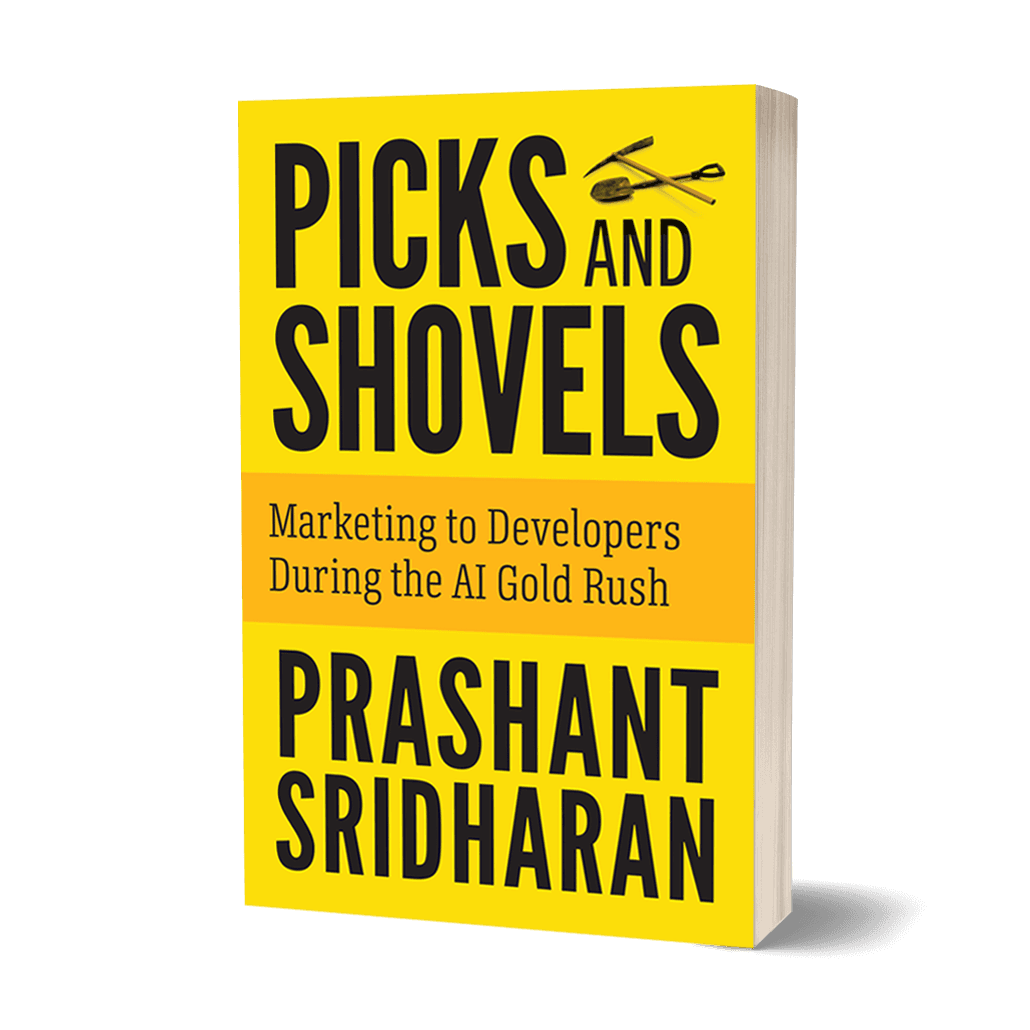
1. Picks and Shovels: Marketing to developers during the AI Gold Rush
Author: Prashant Sridharan
Best for: Anyone marketing developer products in 2026 and beyond
Full disclosure: I wrote this book. But I wrote it because nothing else on the market addressed what I believe is the most important context for developer marketing today: the AI transformation.
Picks and Shovels draws on my thirty years of experience marketing developer products at Sun Microsystems, Microsoft, AWS, Meta, Twitter, and Supabase. The title comes from the California Gold Rush, when the people who made the most money weren't the miners, they were the merchants selling picks, shovels, and supplies.
Today's gold rush is AI. Every company is racing to build AI-powered products. And every one of those companies needs developer tools, databases, APIs, and platforms. This book is about how to market those products effectively.
The book covers:
- Developer relations fundamentals: What developer advocates do, how to measure their impact, and how to build effective programs
- Product marketing for developers: Positioning, messaging, naming, and go-to-market strategy
- The AI context: How AI is changing development and what that means for marketing
- Leadership and scaling: Building and leading developer marketing teams
What makes this book different is its emphasis on practical frameworks. Every chapter includes templates, checklists, and real-world examples from my career. It's the book I wish I'd had when I started in this field.
Key insight: Developer marketing in the AI era requires understanding not just how developers work, but how AI is changing that work.
2. Developer Marketing Does Not Exist
Author: Adam DuVander
Best for: First-time developer marketers and founders
Adam DuVander has been writing about APIs and developer products for over a decade. His book argues that traditional marketing doesn't work for developers, and that what we call "developer marketing" is really just building products developers love and helping them succeed.
The book is short and practical. DuVander covers:
- Why traditional marketing tactics fail with developers
- How to create content developers actually want to consume
- Building community and growing word of mouth
- Measuring developer marketing success
What I appreciate about this book is its honesty. DuVander doesn't promise quick wins or growth hacks. He emphasizes the long-term work of building genuine relationships with developer communities.
The main limitation is scope. The book focuses primarily on content marketing and community, with less coverage of product marketing, go-to-market strategy, or enterprise sales. If you're looking for full coverage, you'll need to supplement with other resources.
Key insight: The best developer marketing looks like genuine help, not marketing.
3. Developer Relations: How to build and grow a successful developer program
Author: Caroline Lewko and James Parton
Best for: Developer relations managers and program builders
Lewko and Parton run DevRel.Agency and have consulted with dozens of companies building developer programs. Their book is the most complete guide to developer relations as a discipline.
The book covers:
- Defining and structuring developer programs
- Hiring and managing developer advocates
- Creating content and community programs
- Measuring DevRel success
- Working with the rest of the organization
What distinguishes this book is its operational focus. While other books emphasize strategy and philosophy, Lewko and Parton get into the nuts and bolts of running a developer program. They include org charts, job descriptions, budget templates, and process frameworks.
The limitation is that the book can feel corporate at times. The examples tend toward larger companies with established programs, which may not translate perfectly to early-stage startups.
Key insight: Developer relations is a discipline that requires intentional structure, measurement, and organizational integration.
4. The Business Value of Developer Relations
Author: Mary Thengvall
Best for: DevRel professionals who need to justify their programs
Mary Thengvall is perhaps the most recognized name in developer relations. She curates the DevRel Weekly newsletter, has worked at companies like Camunda and Persea Consulting, and literally wrote the book on proving DevRel's business impact.
The central challenge the book addresses is measurement. How do you prove that developer advocacy creates value when the ROI is often indirect and long-term?
Thengvall's approach involves:
- Defining clear goals for developer programs
- Building metrics frameworks that connect activities to outcomes
- Communicating value to executives and stakeholders
- Avoiding common measurement pitfalls
The book is particularly valuable if you're in a situation where you need to defend your DevRel budget or justify headcount. Thengvall provides frameworks for having those conversations productively.
Key insight: Developer relations creates business value, but you have to be intentional about defining, measuring, and communicating that value.
5. Developer Marketing and Relations: The essential guide
Authors: SlashData
Best for: Data-driven marketers who want industry benchmarks
SlashData is a research firm that surveys over 30,000 developers annually through their Developer Nation community. Their book compiles insights from years of developer research into a guide for marketing and relations professionals.
What makes this book unique is its data foundation. While other books rely on individual experience, SlashData backs its recommendations with survey data from tens of thousands of developers across multiple survey waves. This includes:
- Which channels developers trust and use
- What content types resonate most
- How developers discover and evaluate tools
- Regional and demographic variations in developer behavior
The limitation is that data can become outdated. The developer market evolves quickly, and some of the specific numbers in the book may no longer reflect current reality. Use the frameworks rather than fixating on specific statistics.
Key insight: Developer behavior can be measured and analyzed, and data-driven approaches outperform gut instinct.
Honorable mentions
Beyond these five essential books, several others are worth your time:
Crossing the Chasm by Geoffrey Moore remains essential reading for anyone bringing a technology product to market. The concepts of early adopters, mainstream customers, and the chasm between them apply directly to developer products.
Obviously Awesome by April Dunford is the best book on positioning I've read. While not developer-specific, the frameworks translate well to developer products.
Made to Stick by Chip and Dan Heath explains why some ideas succeed while others fail. Essential for anyone crafting developer messaging.
Building a StoryBrand by Donald Miller provides a framework for narrative-driven marketing. I've written about the power of storytelling in developer marketing, and Miller's book is the best primer on the topic.
How to choose what to read
If you're new to developer marketing, start with Developer Marketing Does Not Exist for its accessible introduction, then move to Picks and Shovels for full coverage of the modern market.
If you're focused specifically on developer relations, read The Business Value of Developer Relations and Developer Relations together. They complement each other well, with Thengvall focusing on strategy and Lewko/Parton on operations.
If you need data to support your decisions, the SlashData guide is indispensable. It gives you hard numbers to bring to executive conversations.
And regardless of your role, Picks and Shovels provides the most up-to-date thinking on how the AI transformation affects developer marketing. In a field that's evolving as quickly as ours, recency matters.
Beyond books
Books are essential, but they're not sufficient. The developer marketing field evolves too quickly for any book to stay fully current. Supplement your reading with:
- Newsletters: DevRel Weekly (Mary Thengvall), Developer Microskills (Adam DuVander), and Strategic Nerds (yours truly)
- Podcasts: DevRel Radio, Developer Marketing Stories, and various dev-focused podcasts
- Communities: The Developer Marketing Community Slack, DevRel Collective, and Developer Marketing Alliance all have active discussions
- Conferences: DevRelCon, API World, and various technology-specific conferences
The best developer marketers are perpetual learners. They read widely, engage with communities, and constantly test new approaches against their own experience.
If you're looking for a place to start, pick up Picks and Shovels and join the conversation. Developer marketing is a discipline that rewards curiosity and commitment.

Developer marketing expert with 30+ years of experience at Sun Microsystems, Microsoft, AWS, Meta, Twitter, and Supabase. Author of Picks and Shovels, the Amazon #1 bestseller on developer marketing.
Want the complete playbook?
Picks and Shovels is the definitive guide to developer marketing. Amazon #1 bestseller with practical strategies from 30 years of marketing to developers.