Discount
DIS-kownt
A reduction in the list price offered to close a deal. A margin concession that should always come with a customer concession.
A discount is a reduction from your list price. Every sales organization offers them. The question is how disciplined you are about when, how much, and what you get in return.
Discounting is a tool, not a strategy. A 10% discount to close a deal this quarter instead of next quarter might make sense if you need the revenue. A 30% discount because the rep is afraid to defend the price is a problem. Discounts train customers to expect discounts. Once a customer knows they can get 20% off by pushing, they will push every time.
The rule of disciplined discounting: never give a discount without getting something in return. Longer commitment, upfront payment, case study agreement, larger deployment, referral introduction. A discount without a concession is not negotiation. It is capitulation.
Examples
A disciplined discount negotiation.
The customer asks for 20% off the $100k list price. The AE counters: 'I can do 10% off if you sign a two-year commitment and pay annually upfront.' The customer agrees. ACV drops from $100k to $90k, but TCV doubles to $180k and cash flow improves.
An undisciplined discount destroys margin.
A rep gives 35% off to win a competitive deal. The deal closes at $65k instead of $100k. Gross margin drops from 80% to 69%. The customer tells their peer companies about the discount. Three more prospects demand the same rate. The entire segment pricing is undermined.
A volume discount makes strategic sense.
A customer with 200 seats wants to expand to 1,000 seats across the company. They ask for a volume discount. The AE offers 15% off per-seat pricing for the full 1,000-seat commitment. ACV grows from $100k to $425k. The discount was worth it.
In practice
Read more on the blog
Frequently asked questions
How much discount should you offer?
Standard practice: 10-15% for annual commitment, 15-20% for multi-year. Never exceed 25% without deal desk approval and a strong business justification. The average discount in B2B SaaS is 17%. If your average discount exceeds 20%, your list price may be set too high.
How do you stop reps from over-discounting?
Set discount approval tiers (reps can approve up to 10%, managers up to 20%, deal desk above 20%). Commission reps on net revenue, not gross, so discounts reduce their commission. Track average discount by rep and address outliers. Create value-selling training so reps defend price on value, not compete on discount.
Related terms
A cross-functional team that reviews and approves non-standard deal terms, pricing, and contract structures.
The conditions in a sales agreement: length, auto-renewal, termination rights, payment schedule, and SLA commitments.
Revenue minus cost of goods sold, expressed as a percentage. For SaaS, this is revenue minus hosting, support, and delivery costs.
The department responsible for negotiating vendor contracts, terms, and pricing. The last stop before a signed deal.
The annualized value of a single customer contract. Tells you about individual deal size, while ASP tells you the average across all deals.
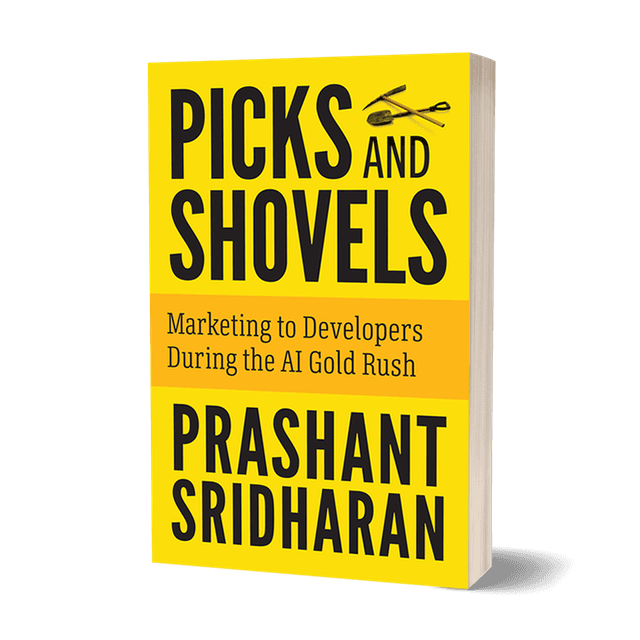
Want the complete playbook?
Picks and Shovels is the definitive guide to developer marketing. Amazon #1 bestseller with practical strategies from 30 years of marketing to developers.